The best CRM for wedding photographers - an honest comparison
Seven tools compared with verified August 2026 pricing and their real limitations on the table - plus the question most comparisons skip: whether a CRM is what you're actually missing.
Last updated: October 9, 2026
One thing before the comparison: we make WeddingRunbook, wedding software that competes for some of the same budget - so read this knowing where it comes from. Many comparison pages in this space earn affiliate commissions on the tools they recommend; this one doesn't. Every price below was checked against the official pricing pages in August 2026, and every tool's gaps are listed next to its strengths. Including ours.
The short answers
- Photography-specific and sensibly priced: Studio Ninja.
- Everything in one suite, galleries included: Sprout Studio.
- Simplest possible photographer CRM: Iris Works.
- Most polished client-facing experience: HoneyBook.
- Deepest customization: Dubsado - if you'll actually invest the setup time.
- Flat, predictable pricing: 17hats.
- Missed deadlines and double-booking are the actual problem: that's an operations problem, not a sales problem - the last section is for you.
Side by side
Prices verified on official pricing pages in August 2026. They change; treat this as a snapshot and check before you buy.
| Tool | Pricing | Photo-specific | Galleries | Best for |
|---|---|---|---|---|
| Studio Ninja | $16-$40/mo, billed yearly | Yes | No | Photography-specific workflows at a fair price |
| Sprout Studio | $19-$69/mo | Yes | Yes | One suite for CRM, galleries, and proofing |
| Iris Works | $14.95-$49.95/mo | Yes | No (integrates) | The simplest photographer CRM |
| HoneyBook | $29-$109/mo, billed yearly | No | No | Polished client experience and AI features |
| Dubsado | $35 or $55/mo | No | No | Deep customization for automation tinkerers |
| 17hats | $60/mo or $600/yr, one plan | No | No | Flat all-inclusive pricing, no tier homework |
| VSCO Workspace (Táve) | $499.99/yr via VSCO One, annual only | Yes | Unclear | Automation depth, if the bundle suits you |
| WeddingRunbook | $9/mo or $90/yr | Yes - photo + video | Yes - in the client portal | Season clarity: calendar-first, not pipeline-first |
Each tool, honestly
Studio Ninja
A frequent recommendation in photography forums, for good reasons: it's built for photographers, priced fairly ($16 to $40 per month billed annually), and every tier includes free data migration with one-on-one training. Gaps: the $16 Starter tier allows only five active jobs and one contact form, so treat Pro at $27 as the real price; there are no built-in galleries; and it's been through its own acquisition (ImageQuix, late 2023, now part of Captura) - the product remains actively developed.
Sprout Studio
The widest feature set here: CRM, galleries, album proofing, and email marketing in one product, $19 to $69 per month. If you currently pay for a CRM plus gallery hosting plus an email tool, the consolidation math is worth running. Gaps: the tiers below Unlimited cap your shoots, galleries, and storage (10 shoots and 50GB on Lite), so a full-time wedding photographer should price the $51+ tiers, and more features in one tool means more tool to learn.
Iris Works
The lowest entry price ($14.95 per month) and the shortest path from signup to actually using it. Photographer-specific, free migration, clean and deliberate scope. Gaps: no gallery delivery (it integrates with Pic-Time and ShootProof), one brand per account, and the mid-tier makes you choose between online booking and email marketing - you need Pro Plus at $49.95 for both.
HoneyBook
The most polished client experience of the group - proposals, payments, and communication feel premium, AI features are included, and every tier has unlimited clients and projects. Gaps: it's a general small-business platform, so nothing about it knows what an engagement session or a second shooter is; the $29 Starter tier (billed yearly) withholds the scheduler and automations, caps lead forms, and keeps "Powered by HoneyBook" on your client touchpoints; and card processing fees sit on top of the subscription.
Dubsado
The customization champion: forms, workflows, and client portals can be built into almost anything, and both tiers ($35 and $55 per month) include unlimited clients. The 21-day trial is genuinely full-featured. Gaps: scheduling and automations - the features you probably want it for - are Premier-only, it isn't photography-specific, and the setup effort is real; even Dubsado's own pricing page acknowledges that complex business tools can be daunting. Photographers who love it tend to be the ones who enjoy building systems.
17hats
One plan, everything included, $60 per month or $600 per year. After comparing tier grids all afternoon, that simplicity is a feature. Gaps: it's the highest entry price in this comparison, it's built for solopreneurs across all industries rather than photographers, and a few conveniences (bank connections, for example) are paid add-ons on top of the flat price.
VSCO Workspace (formerly Táve)
Táve's automation and reporting depth is still there, and migration plus onboarding are free. The structural change matters more than the feature list: since June 2026, new users can only get the full product inside VSCO One at $499.99 per year, billed annually with no free trial (30-day refund window instead). If you want this depth, you're buying a membership, not a subscription. The full Táve story and its alternatives are covered here.
The part nobody says: you may not need a CRM
Every tool above is, at its core, pipeline software: capture the lead, nurture the lead, send the proposal, close. That's the problem CRMs were invented for, and if booking is your bottleneck, one of them is the right purchase.
But listen to how working wedding photographers describe their actual stress: Did I send the timeline questionnaire to the June couple? Which galleries are overdue? Can I take this inquiry, or is that weekend already gone? That's not a sales problem. That's an operations problem - twenty simultaneous projects, each with a fixed date, a predictable lifecycle, and zero tolerance for a missed step. A pipeline view answers "who might book me." It's bad at answering "what must happen this week," which is why so many photographers own a CRM and still run their real season from a wall calendar and memory.
That gap is the one WeddingRunbook exists for - full disclosure again, our product. Technically it's a CRM too (clients, quotes, invoices, pipeline), but it's built calendar-first: the season on one screen, every wedding - or portrait day, or any dated event - running the same inquiry-to-delivery lifecycle, with the next step always visible, for photographers and videographers working solo or as a team. It's $9 per month or $90 per year after a 14-day free trial, the client portal (galleries, chat, e-signed contracts, quotes, invoices, questionnaires) is live, and the iOS app is in beta. It has no lead capture forms, no automated email sequences and no card payments inside the portal, which tells you what it is for. If your bottleneck is booking, buy a CRM from the list above. If your bottleneck is running what you've already booked, this is the shape of tool to look at - whether it's ours or a system you build yourself.
How to actually choose
- Name your bottleneck first. Booking more weddings is a CRM problem. Running the weddings you have is an operations problem. Tools that promise both usually do one well.
- Price the tier you'd really use. Entry tiers here cap active jobs, withhold schedulers, or keep vendor branding. Compare the $27-$51 reality, not the $15-$19 banner.
- Count your current subscriptions. If CRM + galleries + email tools total more than a suite like Sprout, consolidate. If you love your gallery service, don't pay for a second one inside a suite.
- Use the trials on a real booking. Almost every tool above offers a trial or refund window. One actual client through the system tells you more than any comparison table - including this one.
Common questions
What's the cheapest CRM for wedding photographers?
Technically, ours: WeddingRunbook is $9/month or $90/year after a 14-day free trial, with unlimited jobs and clients and the client portal included - read that price knowing it's the newest tool on the list. Among the established players, Iris Works ($14.95/month) and Studio Ninja ($16/month billed annually) are the cheapest photography-specific picks as of August 2026 - and check the caps: Studio Ninja's entry tier allows only five active jobs, which a working wedding photographer outgrows immediately.
Is HoneyBook worth it for wedding photographers?
It has the most polished client-facing experience of the group and unlimited clients on every tier. The honest caveats: it isn't photography-specific, so wedding workflows are yours to build, and the $29 entry tier withholds the scheduler and automations most photographers actually want - budget for Essentials at $49/month.
Do I need a CRM if I only shoot 10 weddings a year?
At that volume your real risks are missed deadlines and double-booking, not lead management. A calendar-first system, a reliable contract tool, and a clean invoicing setup can serve you better than a full CRM you'll configure for a pipeline you don't have.
What happened to Táve?
It was acquired by VSCO in May 2025 and is now VSCO Workspace. Since June 2026 the full product is only sold inside the $499.99/year VSCO One membership. Existing legacy plans keep renewing at their existing pricing.
Is WeddingRunbook a CRM?
Technically yes - clients, quotes, invoices, and a pipeline are in there. The distinction is what it's built around: a traditional CRM starts with the sale, WeddingRunbook starts with the calendar and the event lifecycle, for photographers and videographers working solo or as a team. The client portal (galleries, chat, e-signed contracts, quotes, invoices, questionnaires) is live, and an iOS companion app is in beta.
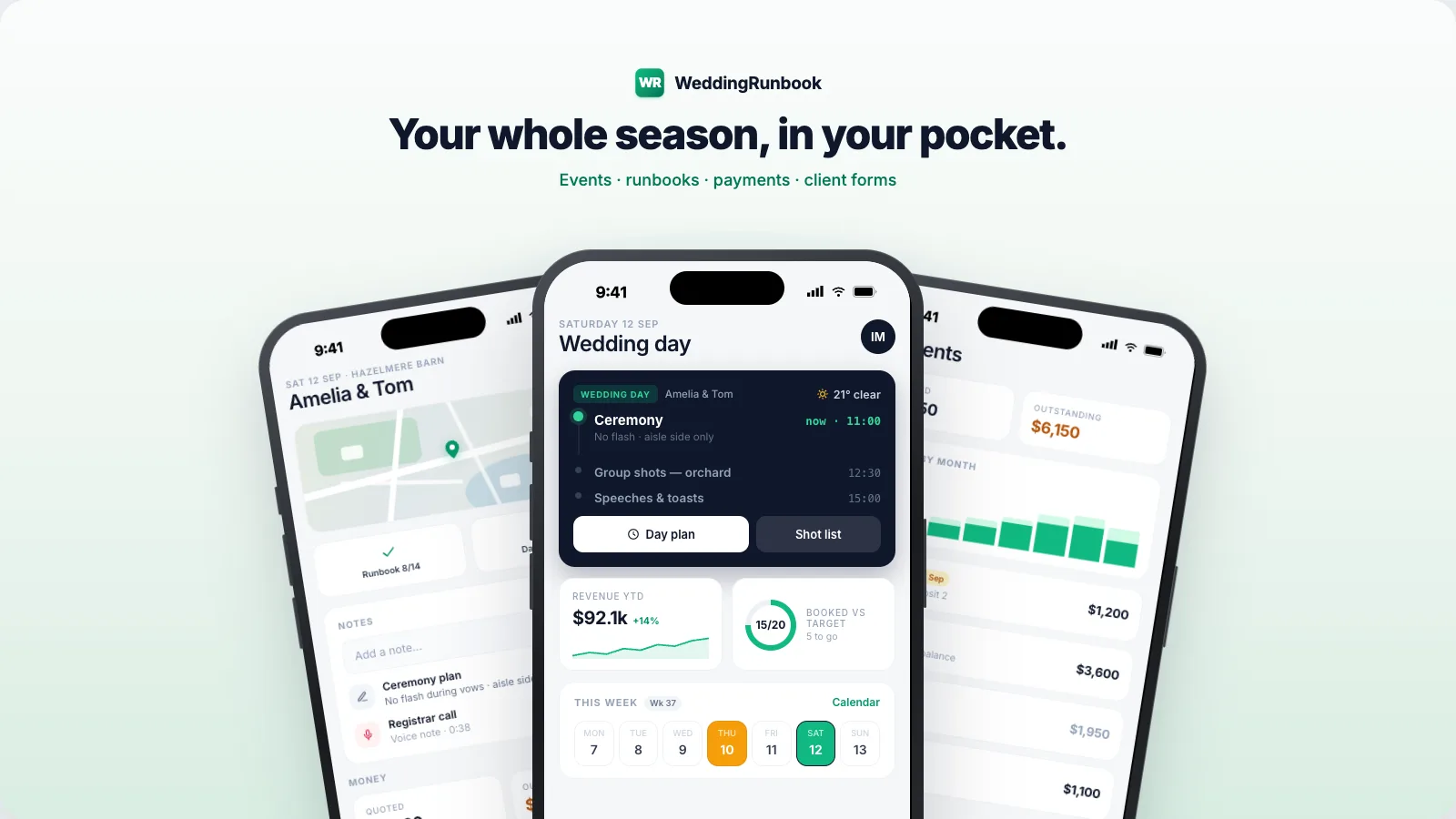
If your problem is the season, not the pipeline
WeddingRunbook runs every wedding on one calendar - deadlines, tasks, and next steps from inquiry to delivery. Try it free for 14 days, then $9/month or $90/year.
Start your season14-day free trial - no card required.