Wedding photography questionnaire templates
Six client questionnaires tied to fixed points in the wedding lifecycle - the questions to ask, when to send each one, and what the answers feed.
Last updated: August 19, 2026
Why fixed questionnaires beat email threads
Every photographer already collects this information - the ceremony time, the family groups, the getting-ready address. The question is whether it arrives as structured answers at a predictable moment, or as fragments spread across four email threads, two text messages, and a phone call you half-remember. At two weddings a year, the thread method holds. At twenty, it fails quietly: the answer exists somewhere, finding it costs more than asking again, and so the same couple gets asked the same question twice - and notices.
A questionnaire tied to a fixed lifecycle point solves both problems at once. Each question is asked exactly once, at the moment the answer becomes useful: booking details at booking, timeline details when the timeline is real, delivery preferences when the shooting is done. And the answers land in one place, attached to the wedding, instead of in an inbox sorted by date.
The six templates below follow that structure. They are the questionnaire templates every new WeddingRunbook account starts with, adapted here so you can rebuild them in any form tool. Two go out at booking, one before the engagement session, two at the final-details stage four to six weeks out, and one after the wedding.
At booking: wedding essentials
Send this with the countersigned contract or the welcome guide. It opens the file: the confirmed date drives every deadline that follows, the guest count and locations shape the coverage plan, and the couple's top-three answer becomes the first draft of your priorities for the day - long before anyone builds a run sheet.
Wedding date
Confirm it in writing even when you are sure you know it. Every deadline in the plan hangs off this one field, and a transposed date caught at booking costs nothing.
Estimated guest count
Guest count shapes coverage. Formals for 180 guests take longer than for 60, and the number feeds the second-shooter decision.
Preparation location
Your arrival point on the day, and the first thing to scout: the light in the room and the drive time to the ceremony.
The top three moments you want captured
Make this one required. Limiting it to three forces a real ranking, and the answer decides where coverage goes if the day runs late.
Preferred coverage start and end times
If the couple's expectations and the package hours disagree, this is where it surfaces - at booking, while it is still a conversation rather than a dispute.
Early planning: photo style and preferences
Send this in the first weeks after booking. There is no deadline pressure on it, and couples enjoy answering it, which makes it a good early touchpoint. The answers do their work months later - in shot planning for the day, in the brief you hand a second shooter, and at the edit, where the tone answer keeps a delivered gallery from missing the mark.
Preferred photography style - candid, editorial, classic, or a mix
This is the expectation you will be graded against. A couple that answers classic wants directed, composed groups, not thirty minutes of documentary distance.
Preferred editing tone - light and airy, true to color, or moody
Locks the look while it is still cheap to discuss. Style disagreements discovered after gallery delivery are the expensive kind.
Details to prioritize - decor, stationery, dress, rings, heirlooms, guests
The detail window on a wedding day is finite, and this ranks it. An heirloom mentioned here is a shot you would never have known to take.
Photos or scenarios you want to avoid
The most protective question in the set. It surfaces everything from a pose the couple genuinely dislikes to a family situation you need to shoot around - before the day, not during it.
Before the engagement session
If the package includes an engagement session, send this two to three weeks before it. The session usually lands a couple of months before the wedding, so the questionnaire doubles as a mid-planning touchpoint - and the session itself is a low-stakes rehearsal for how the couple takes direction from you.
Preferred session location
A place that means something to the couple beats a scenic default, and asking early flags permits, fees, and travel while there is still time to handle them.
How many outfits are you planning?
Outfit count sets the structure of the session. Each change costs ten to fifteen minutes and usually a location shift, so two outfits is a different session than four.
The vibe you want - romantic, playful, editorial, or natural
One word of direction that changes how you shoot, how you direct, and which spots you pick.
How you plan to use the photos - save-the-dates, wedding website, prints, social media, a guestbook
Usage decides orientation and crop. A save-the-date needs negative space for text; a guestbook spread wants horizontals.
Four to six weeks out: timeline and logistics
This is the final-details questionnaire, and its timing matters most of all. Send it four to six weeks before the wedding, ahead of the final consultation, so the consult becomes a review of written answers instead of a live interview. The answers feed directly into your wedding day run sheet: the ceremony time anchors it, the locations set the travel buffers, and the first-look answer decides the shape of the whole afternoon.
Your current timeline, even if it is still a draft
You need the couple's version of the day before you can build yours. The gaps in their draft are the agenda for the final consultation.
Are you doing a first look?
The single answer that restructures the day. With one, portraits and most formals happen before the ceremony; without one, cocktail hour becomes your busiest block.
Ceremony start time
The fixed point everything else is built around. Make it required.
Are golden hour portraits important to you?
This sets sunset math against the dinner schedule while the schedule can still move. If the two collide, the couple, the planner, and the DJ all need to know about the ten-minute exit in advance.
Key locations for the day
Every location is a transition to plan and buffer. Drive times belong in the run sheet, not in the category of things discovered on the day.
Four to six weeks out: family and group photos
Send this together with the timeline questionnaire - they feed the same consultation. Its output is the printed family formals list, the single document most correlated with whether the portrait block survives. An unconfirmed list is how photographers end up standing in a field shouting names, and it is also what your second shooter and the coordinator work from, so the answers reach beyond your own camera.
How many formal family groups do you expect?
Multiply by three minutes per group and you have the length of the formals block. Twelve groups do not fit a fifteen-minute slot, and it is better to prove that with arithmetic a month out.
Best day-of contact for family coordination - a name and a phone number
Never the couple. A designated wrangler who knows names and faces turns a forty-minute round-up into fifteen.
Group photo priorities, in order
Named groups, ranked, so that if the block gets cut short you lose the bottom of the list and not the grandparents.
Family dynamics we should know about
Divorced parents who should not be posed together, a recent loss to handle gently. Couples answer this honestly in writing and rarely volunteer it in person.
After the wedding: delivery and album preferences
Send this in the first week after the wedding, while the couple's attention is entirely on the photos. It sets delivery expectations in both directions - you learn what they value, they learn there is a process - and it opens the album conversation at the one moment it reads as service rather than sales.
What matters most in your gallery delivery - fast turnaround, a large variety, detailed editing, or a balance
Different couples genuinely want different things, and knowing which prevents both the rushed gallery and the 'when will they be ready' thread.
Are you interested in album design?
Asked here, it is a natural next step. Asked cold three months later, it is a sales email.
Must-have moments for your album
The couple's memory of the day in their own words, days after it happened. It is the best culling guide you will get, and a ready-made table of contents for the album.
How to send them
Any form tool works. Google Forms, Typeform, Jotform, even a well-structured PDF - the software has never been the hard part. Two disciplines matter more than the tool. First, fixed timing: each send is tied to the lifecycle stage, not to the day you happen to remember. Second, one home for the answers: responses live with the wedding, not in a forms dashboard sorted by submission date.
If you run your business from a spreadsheet and a calendar, that means putting the send dates in at booking - contract signed, engagement session minus three weeks, wedding minus six weeks, wedding plus one week - and pasting the answers into the wedding's notes when they come back.
WeddingRunbook builds this in. Questionnaires are part of the product: the six templates above are the ones every new account starts with, sending them is a task on each event's runbook, and the answers live on the event itself, next to the timeline and the invoices. It is calendar-first software for wedding photographers and videographers - technically a CRM, but built around the event rather than the sale - so a questionnaire is a step in the event's lifecycle, not a form floating in a separate inbox.
Common questions
How many questionnaires should I send for one wedding?
Four sends across the lifecycle is the practical ceiling: essentials and style at booking, engagement prep if there is a session, timeline plus family formals together at four to six weeks out, and delivery preferences after the wedding. Several short questionnaires at the right moments get better answers than one long form at the wrong one.
When should the final details questionnaire go out?
Four to six weeks before the wedding, and always before the final consultation. The consult works when it is a review of written answers rather than a live interview - you walk in with a draft timeline and a formals list and walk out with both confirmed.
What if the couple doesn't fill it out?
Chase once by email a week after sending, then put the unanswered questions on the final consultation agenda and ask them live. The questionnaire is a tool for getting answers early, not a gate. The answers themselves are what you cannot shoot without - particularly the ceremony time and the family groups.
Do I need special software to send client questionnaires?
No. Google Forms, Typeform, or a document the couple fills in all work. The two things that matter are timing tied to the wedding's lifecycle stage and answers stored with the wedding rather than scattered across a forms inbox and email threads. Dedicated tools automate both, but the discipline transfers to any stack.
Should I ask about family dynamics directly?
Yes, in writing, with neutral wording - 'anything about family dynamics we should know' invites an honest answer without forcing anyone to raise it face to face. Couples rarely volunteer this in person, and it is the difference between quietly photographing divorced parents in separate groups and finding out at the formals.
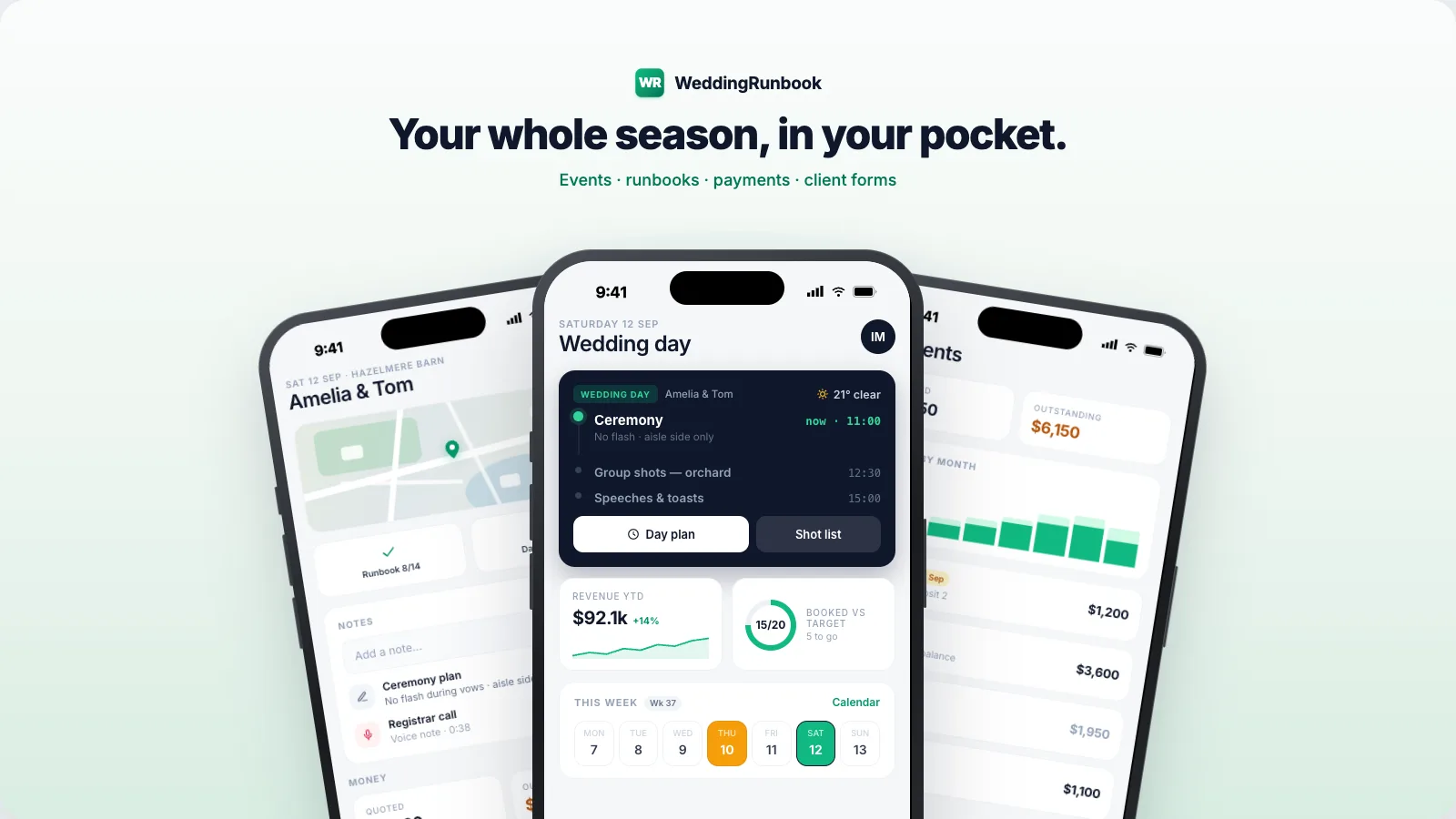
Questionnaires are built in, not bolted on.
WeddingRunbook is calendar-first software for wedding photographers and videographers - weddings first, any dated event after that. The templates in this guide ship with every new account. Free for 14 days, then $9 a month or $90 a year - one plan, everything included. The client portal - galleries, chat, e-signed contracts, quotes, invoices, questionnaires - is live, with 20 GB of galleries included, and the iOS app is in beta.
Start your season14-day free trial - no card required.