The wedding photography workflow, from inquiry to archive
The complete per-wedding lifecycle for working photographers - seven phases, a concrete checklist for each, and why running the same list every time is what keeps a full season from falling apart.
Last updated: August 23, 2026
Why the workflow is the business
A wedding is not a shoot. It is a project that runs for a year or more: an inquiry, a consult, a contract, a questionnaire, a timeline, ten hours of coverage, a backup routine, weeks of editing, a delivery, an album conversation, and an archive. The photography is one day of it. Everything else is workflow.
At five weddings a year, you can hold all of that in your head. At twenty or forty, you can't - and the failure mode is never the photos. It's the inquiry that sat unanswered over a busy weekend, the questionnaire that went out late, the family formals list nobody confirmed, the sneak peek that slipped from three days to three weeks. Every one of those is a dropped step, and dropped steps are what a workflow prevents. This guide walks the full lifecycle in order, with a checklist for each phase - a template where the steps stay the same for every wedding and only the dates change.
The seven phases at a glance
| Phase | Window | Done means |
|---|---|---|
| 1. Inquiry + booking | First two weeks | Signed contract, paid retainer, date on the calendar |
| 2. Pre-wedding | Booking to one week out | Questionnaire answered, formals list confirmed, final timeline sent |
| 3. Wedding day | The day | Coverage shot to plan, both cards intact |
| 4. Ingest + backup | Within 24 hours | Three copies, two media, one offsite - verified |
| 5. Cull + edit | Weeks one to eight | Sneak peek out, full gallery finished |
| 6. Delivery | Your contract date | Gallery delivered with print release and clear expectations |
| 7. Album + archive | One to six months after | Album conversation had, files archived, wedding closed out |
Each phase ends with an output, not an activity. "Working on edits" is not a state a wedding can sit in for two months; "gallery finished, delivery scheduled" is.
Phase 1: Inquiry and booking
Bookings are won in the first reply. Couples commonly inquire with several photographers in the same evening, and the one who answers first with a real answer - not "thanks, I'll be in touch" but availability, a pricing anchor, and a next step - starts the conversation everyone else has to interrupt. Response time is a discipline, not a personality trait: a saved template you personalize in the first line makes same-day replies possible even in October.
The consult is where the booking actually happens. Get on a call rather than trading emails - couples book a person, and twenty minutes of conversation answers more objections than a PDF ever will. And hold one rule absolutely: the date is not reserved until the contract is signed and the retainer is paid. A held date with no contract is a date you can lose twice - once to this couple, and once to the couple you turned away for them.
- Reply the same day - confirm the date is open, anchor the price range, and propose a consult time.
- Track every inquiry outside your inbox - an inbox is where inquiries go to be forgotten.
- Hold the consult within a week - momentum decays fast; a call booked for "sometime next month" rarely converts.
- Send the proposal within 24 hours of the consult - contract and retainer invoice together, one link, one action.
- Confirm the booking in writing - what happens next, when they'll hear from you, and when the engagement session lands.
- Decline gracefully when the date is taken - a fast, kind referral to a colleague is marketing you didn't pay for.
Phase 2: Pre-wedding
Everything that makes the wedding day calm happens in this phase, and most of it has a natural deadline relative to the date. The engagement session comes first - not as an upsell, but as a rehearsal. It teaches the couple how to be directed by you, and it teaches you how they move together, which is worth an hour of awkward portraits on the day itself.
Around eight weeks out, send the questionnaire: exact addresses for every location, phone numbers for the planner and one of the bridesmaids or groomsmen, the vendor list, the VIPs, and any family situations you need to know about before you cheerfully ask the wrong two people to stand together. The family formals list deserves its own follow-up - names, not roles ("Susan and Robert", not "mom's side"), and a hard cap on groupings, because every group past a dozen is time taken from couple portraits.
Then, at the final consult four to six weeks out, build the timeline. That document is its own craft - the fixed points, the buffer math, the sunset planning - and we've covered it in full in the wedding day run sheet guide, including a free template. Build it there; this checklist just makes sure it happens.
- Schedule the engagement session early - pick the season for the light, not the convenience.
- Questionnaire out at eight weeks - chase it at six; unanswered questionnaires do not answer themselves.
- Family formals list confirmed in names - and a designated family wrangler who knows the faces.
- Final consult and timeline at four to six weeks - send the finished run sheet one to two weeks out, copied to the planner.
- Gear prep the week of - batteries charged, cards formatted in camera, dual slots confirmed, backup body packed.
Phase 3: The wedding day
If the first two phases happened, the day itself is execution, not invention: you arrive with a printed run sheet, a confirmed formals list, and a plan for sunset, and your only jobs are to be in position early and to adapt when the day slips - which it will, in the places the buffers you built are waiting for. The full minute-by-minute structure, a realistic 8-hour example, and the adaptation notes for different coverage lengths live in the run sheet guide. One workflow rule belongs here, though, because it bridges into the next phase: shoot to both card slots all day, and no card gets formatted, cleared, or even reviewed-and-deleted at the venue. The day ends with every frame in two places.
Phase 4: Ingest and backup
This is the phase where careers end, so it gets rules instead of suggestions. The standard is 3-2-1: three copies of every wedding, on two different types of media, with one copy offsite. A working drive and a backup drive on the same desk are two copies and one fire. The offsite copy - cloud storage, or a drive that lives somewhere else - is what turns a disaster into an inconvenience.
Ingest the same night, however tired you are, or within 24 hours at the outside. Copy with software that verifies the transfer rather than dragging folders and hoping, and work from the copied files - never cull on the card itself. The cards are your third copy for now: cased and untouched until the backups are verified, and many photographers leave them intact until the gallery is delivered.
- Ingest within 24 hours - with verified (checksummed) copies, not a drag-and-drop.
- Three copies before you sleep easy - working drive, second drive, offsite or cloud.
- Cards stay untouched - cased and labeled, formatted only after the gallery ships.
- One folder structure for every wedding - date and couple name, same subfolders every time, so nothing is ever "somewhere."
Phase 5: Cull and edit
The sneak peek comes first, and it is a business task, not an editing task: a small set of the day's strongest frames, delivered while the couple is still floating - within two or three days is the common promise. It buys you patience for the full gallery, and it lands in front of every guest and vendor at the exact moment they're most likely to share it. Edit the peek to finished standard; it is the first impression of the whole delivery.
Then cull in passes, not in one agonizing crawl. The first pass is fast and binary - kill the blinks, the misfires, the test frames, the fifth identical candid - with no "maybe" allowed, because a maybe is a decision you've promised to make twice. The second pass picks the best frame of each moment against your target delivery count. Two disciplined passes beat five anxious ones.
Editing is where consistency matters more than perfection. Anchor a look per lighting scene - getting ready, ceremony, golden hour, reception flash - sync it across the scene, then refine the frames that deserve it. A gallery where image 400 matches image 40 reads as professional in a way no single heroic edit can. Work on a calibrated monitor and export in one batch.
- Sneak peek within 72 hours - finished standard, with a note saying when the full gallery lands.
- Cull pass one: rejects only - binary decisions, no maybes.
- Cull pass two: best of each moment - against the delivery count you promised.
- Anchor edits per lighting scene, then sync - consistency first, hero edits second.
- Track the contract delivery date - the edit is scheduled backward from it, not forward from your mood.
Phase 6: Delivery
Delivery is a handoff, and handoffs fail on ambiguity. The gallery email should answer every question before it's asked: how many images, how to download them (and that they should - today, to their own storage), how long the gallery stays online, and what they're allowed to do with the files. That last one means a written print release: commonly the couple gets personal printing and sharing rights while you keep the copyright - whatever your arrangement, it goes in writing with the gallery, not in a conversation nobody can find later.
- Deliver on or before the contract date - early feels like a gift; late erodes everything the photos earned.
- One delivery email that answers everything - count, download steps, gallery lifespan, print release attached.
- Tell them to download now - and say plainly when the gallery expires and what your archive policy is.
- Set the reprint expectation - where to print, and what happens if they need files again in five years.
Phase 7: Album and archive
The wedding isn't over at delivery; it's over when the loop is closed. Albums sell best as a pre-designed draft, not a blank-slate offer - "here's what your album would look like" converts where "let me know if you want an album" dies quietly. A follow-up a few weeks after delivery, while the gallery is still being shared around, is the natural moment.
Archiving is the last workflow step and the easiest to skip. Delivered JPEGs are small - keep them effectively forever. RAWs are a policy decision: keep them for the window your contract states, then act on it. And close the wedding out deliberately: review request, referral thank-you, and the couple moved to "complete" in whatever system you run, so next season's list only shows weddings that still need you.
- Album follow-up two to four weeks post-delivery - lead with a designed draft, not a question.
- Archive to the same 3-2-1 standard - finished files indefinitely, RAWs per your written policy.
- Ask for the review and the referral - one email, sent while the gallery is still the best thing in their inbox.
- Mark the wedding complete - a lifecycle that never formally ends is a to-do list that never shrinks.
Why systematized photographers stop dropping steps
Read back through the phases and count the steps: somewhere around forty per wedding, spread across a year, each with its own deadline. Now multiply by a real season - eight weddings in flight, every one in a different phase. One couple needs a questionnaire chased, another needs a timeline finalized, a third is waiting on a sneak peek, and two inquiries arrived overnight. No one's memory survives that. It doesn't fail loudly, either - it fails as a small silence, a step that simply never happened, discovered three weeks later by an email you didn't want to receive.
The fix is old and unglamorous: a runbook. Write the lifecycle down once - every step, in order, with dates set relative to the wedding day - and then run that same list for every booking. New wedding comes in, and the runbook generates its schedule: questionnaire at eight weeks out, timeline consult at five, backup check the day after, album follow-up three weeks post-delivery. The question stops being "what am I forgetting?" - which has no answer - and becomes "what is due today?" - which does. Whether the runbook lives in a spreadsheet, a task manager, or software built for it matters less than that it exists, because the photographers who look effortless in peak season aren't remembering more than you. They stopped relying on remembering at all.
Common questions
What are the phases of a wedding photography workflow?
Seven, in order: inquiry and booking, pre-wedding preparation, the wedding day itself, ingest and backup, cull and edit, delivery, and album and archive. Each phase has a concrete output that must exist before the next one starts - a signed contract, a confirmed timeline, verified backups, a delivered gallery. The workflow is the same ordered list run for every wedding you book.
How quickly should I respond to a wedding inquiry?
The same day, and within a few hours if you can. Couples commonly inquire with several photographers at once and book whoever answers first with a real answer - availability for their date, a pricing anchor, and a next step. A saved reply template you personalize in the first line makes same-day response sustainable even in peak season.
How do I turn this into a wedding photography workflow template?
Copy the checklist from each phase of this guide into whatever tool you run your business from, then attach dates to each item relative to the wedding day - questionnaire at eight weeks out, final timeline at four, backups within 24 hours after, sneak peek within 72. Once the dates are relative, every new booking generates its own schedule, and that per-wedding list is your template doing its job.
How long should wedding photo delivery take?
Whatever your contract says - that is the only number that matters to the couple. Four to eight weeks is a common promise for full galleries; the discipline is picking a date you can hit in your busiest month, writing it into the contract, and then beating it. Delivering a week early feels like a gift; delivering a day late feels like a breach.
How long should I keep RAW files after delivery?
Long enough to survive any reasonable reedit or dispute, and exactly as long as your contract states. Many photographers keep RAWs for a fixed window after gallery delivery and keep the delivered JPEGs indefinitely, since finished files are small and clients lose galleries. Whatever you choose, write it down - an archive policy only protects you if the couple agreed to it.
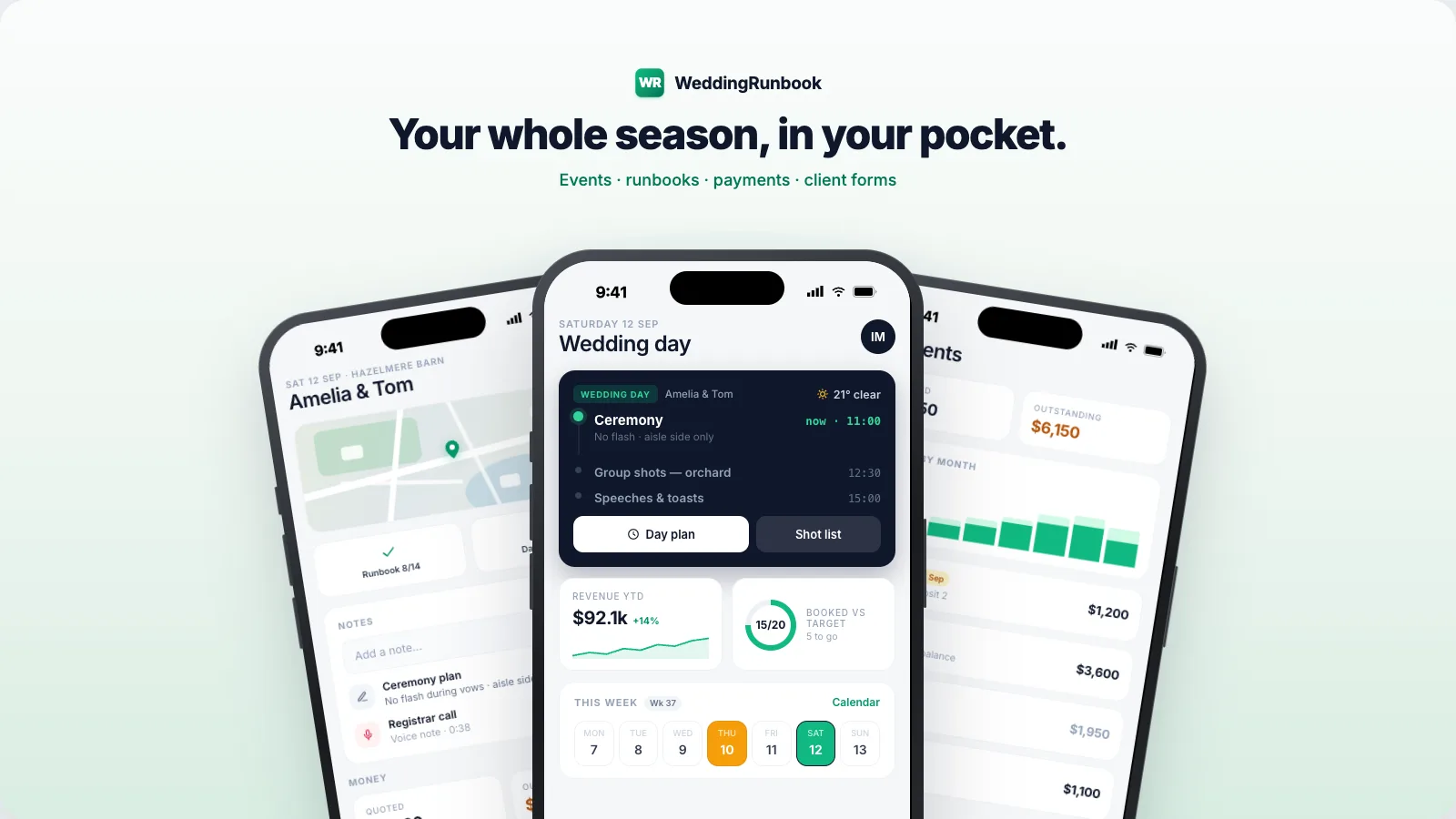
This lifecycle is what WeddingRunbook is built to run
WeddingRunbook is calendar-first software for wedding photographers and videographers - technically a CRM, but built around the event rather than the sale. Weddings come first, and any dated event fits. Every booking runs the same lifecycle from inquiry to delivery, laid out on one calendar. Free for 14 days, then $9 a month or $90 a year - one plan, everything included. The client portal - galleries, chat, e-signed contracts, quotes, invoices, questionnaires - is live, with 20 GB of galleries included, and the iOS app is in beta.
Start your season14-day free trial - no card required.