The wedding day run sheet for photographers
A minute-by-minute plan for the one day you can't reshoot - what to put in it, a realistic 8-hour example, and a free template you can adapt in twenty minutes.
Last updated: August 23, 2026
What a run sheet is - and why yours is different
A run sheet (in the US, usually a wedding day timeline) is the minute-by-minute schedule of the wedding day. The planner has one. The venue has one. The DJ probably has one. Yours is different, because yours answers a different question: not "what happens next" but "where do I need to be standing, with which lens, before it happens."
The planner's timeline says "5:15 - cocktail hour." Your run sheet says "5:15 - shoot the reception room before guests touch it, then guest candids, then eat, because there's no other window." Same day, different document. The photographers who look calm at weddings aren't improvising better than everyone else - they wrote the decisions down beforehand, so the day only has to be executed, not invented.
The three fixed points every run sheet is built around
Before filling in any rows, anchor the three times you can't move, then build everything else around them:
- The ceremony. Everything before it is a countdown; everything after it is a negotiation with the reception schedule.
- Sunset. Golden hour starts roughly an hour before it. If sunset lands during dinner, you need a planned ten-minute exit with the couple - and the couple, the planner, and the DJ all need to know about it in advance.
- Travel between locations. Every location move costs ten to fifteen minutes more than anyone believes. Count the moves, add the buffer, and defend it.
A realistic 8-hour run sheet (4:00 pm ceremony)
This is a working example for a single-venue wedding with a first look and a 4:00 pm ceremony, sunset around 7:45 pm. Times are starting points, not gospel - the adaptation notes below cover the common variations.
| Time | Block | Your job | Notes |
|---|---|---|---|
| 12:30 | Arrive + details | Flat lay: dress, rings, invitations, shoes, perfume. Venue exteriors while the light is neutral. | Ask the coordinator for both rings when you arrive. |
| 13:00 | Getting ready | Candids, detail shots, window-light portraits of the couple's people. | Agree the dress-on time with the coordinator now, not later. |
| 14:00 | Dress on | Dress-on moments, parents' reactions. | Second shooter covers the groom's side in parallel. |
| 14:30 | First look + couple portraits | Direct the reveal, then 30 minutes of portraits. | Scout the spot in advance; watch the light direction. |
| 15:15 | Bridesmaids, groomsmen + family formals, part 1 | Work the printed formals list, largest groups first. | Assign a family wrangler who knows names and faces. |
| 16:00 | Ceremony | Processional, vows, rings, kiss, recessional. | Silent shutter. Confirm the officiant's photo rules beforehand. |
| 16:30 | Cocktail hour | Guest candids, plus the reception room while it's untouched. | Eat something now if dinner is late. |
| 17:15 | Remaining formals + portraits | Any groups you missed; 15 minutes of couple portraits. | Golden hour starts about an hour before sunset - plan for it. |
| 18:00 | Reception entrance + first dances | Entrances, first dance, parent dances. | Confirm the running order with the DJ or band first. |
| 18:30 | Dinner + toasts | Photograph each speaker and the couple's reactions. | Swap backup cards during dinner. |
| 19:00 | Golden hour exit | Take the couple out for ten minutes of sunset portraits. | The shot they'll frame. Protect this slot. |
| 19:45 | Open dancing | Flash setup, dance floor coverage. | Set up flash during dinner so you're ready. |
| 20:30 | Send-off | Position guests in two lines, brief the couple to walk slowly. | A staged early exit can save hours of coverage. |
Download this template as a CSV - it opens in Google Sheets, Excel, or Numbers, and it's yours to edit. No email required.
Adapting it to your coverage
6-hour coverage: start at dress-on and end shortly after the first dances. Getting-ready candids and the send-off are the first things to go; a staged "fake exit" right after the first dance gives the couple their exit photos without paying for three more hours.
10 to 12 hours: the extra time belongs at the start (full getting-ready coverage, both sides) and the end (real send-off). The middle of the day doesn't stretch - dinner is dinner.
No first look: all couple portraits and most formals move to after the ceremony. Cocktail hour becomes your busiest block of the day, so brief the planner that you'll need the couple for 45 minutes of it - and get the family formals done first, while everyone is still nearby.
Church ceremony + separate reception: add a full travel block, not a buffer - 30 minutes minimum. Confirm the church's photography rules (some restrict movement or flash) and plan formals for whichever location has better light, not whichever is more convenient.
Building yours in twenty minutes
- Write down the three fixed points: ceremony time, sunset time, location moves.
- Place the ceremony, then work backward to your arrival, block by block.
- Add ten to fifteen minutes of buffer to every transition and double it for hair and makeup.
- Place the golden-hour portrait slot and tell the planner and DJ it exists.
- Attach the confirmed family formals list - names, not "mom's side."
- Send it to the couple and the planner one to two weeks out, and bring a printed copy.
The five mistakes that break wedding day timelines
- No buffer anywhere. A timeline that works only if nothing slips is a timeline that fails by 2:00 pm.
- An unconfirmed family formals list. The single biggest cause of lost portrait time is standing in a field shouting names.
- Ignoring sunset math. Golden hour is not a vibe, it's a time you can look up. If it collides with dinner, that's a conversation for the consult, not the day.
- Treating the planner's timeline as your run sheet. It tracks the day; it doesn't track your coverage, gear, or second shooter.
- Keeping it in your head. It worked for your first ten weddings. It stops working the season you're running fourteen of them at once.
Common questions
What's the difference between a run sheet and a wedding day timeline?
They're the same document with regional names. Run sheet is the everyday term in Australia, New Zealand, and much of the UK events world; photographers in the US usually say wedding day timeline or shot schedule. Whatever you call it, it's the minute-by-minute plan for where you need to be and what you need to capture.
Who builds the run sheet - the photographer, the planner, or the couple?
The planner's master timeline and your run sheet are different documents. The planner tracks vendors, deliveries, and the couple's day; your run sheet tracks coverage - where the light is, when you move, what your second shooter does. Build yours from the planner's timeline, don't substitute one for the other.
When should I send the run sheet to the couple?
Draft it at the final consult, usually four to six weeks out, once the ceremony time and locations are fixed. Send the final version one to two weeks before the wedding, after the couple has confirmed the family formals list, and copy the planner or coordinator.
How much buffer should I build in?
Ten to fifteen minutes for every location move, and pad the getting-ready block generously - hair and makeup run late more often than any other part of the day. If everything somehow runs on time, you spend the spare minutes on extra portraits; nobody has ever complained about that.
Do I need a run sheet for a small wedding or an elopement?
A shorter one, yes. The two things that sink coverage - sunset math and an unconfirmed family photo list - don't care how many guests there are.
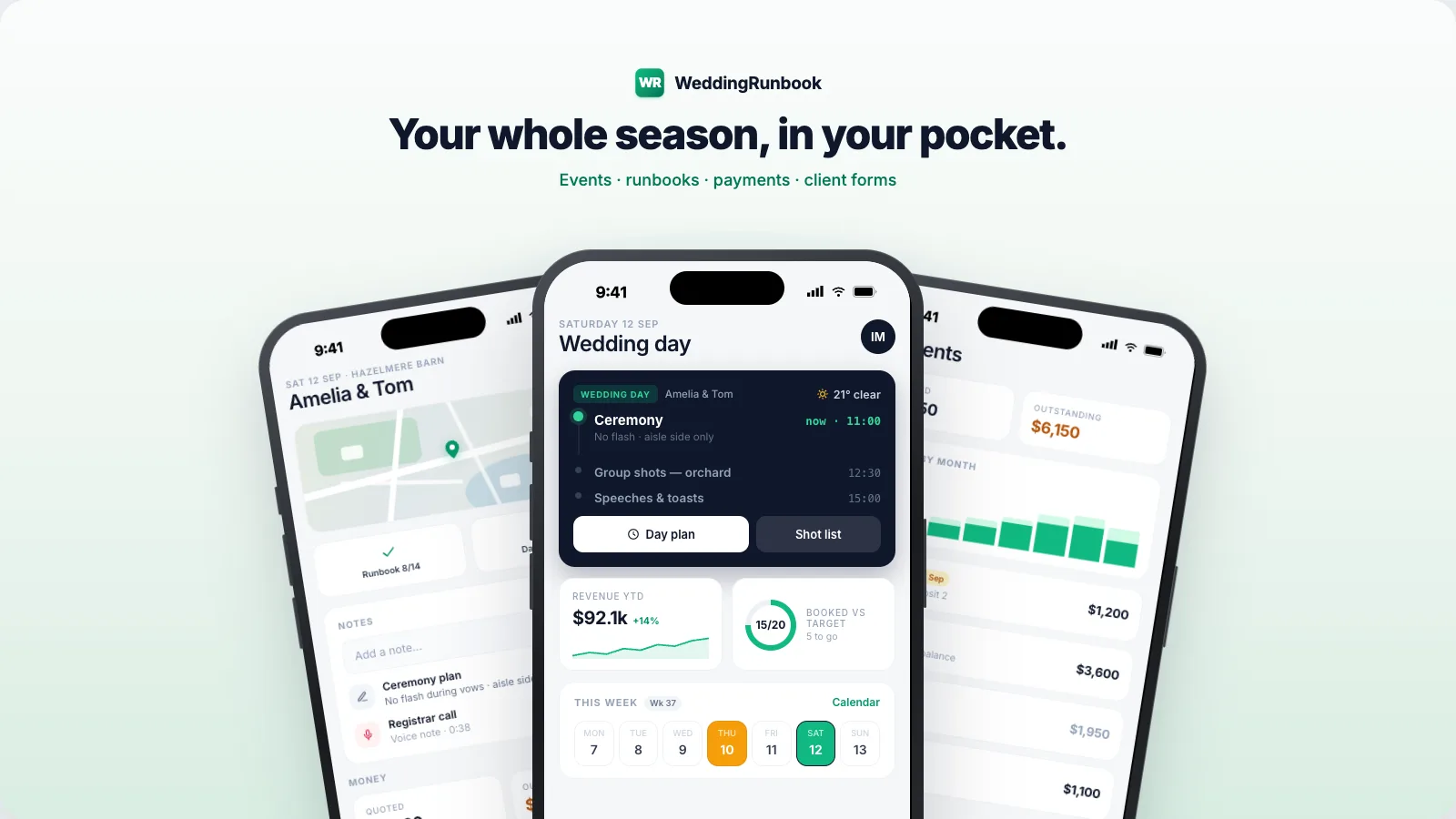
Run sheets are one day. WeddingRunbook is the whole season.
WeddingRunbook is calendar-first software for wedding photographers and videographers. Every wedding gets the same lifecycle from inquiry to delivery - deadlines, tasks, and the wedding day itself - so nothing lives in your head. Free for 14 days, then $9 a month or $90 a year - one plan, everything included. The client portal - galleries, chat, e-signed contracts, quotes, invoices, questionnaires - is live, with 20 GB of galleries included, and the iOS app is in beta.
Start your season14-day free trial - no card required.