First look or no first look, decided as a timeline question
Most advice argues the emotional case. This one shows what each choice does to the clock, hour by hour, so you can advise a couple instead of deciding for them.
Last updated: August 23, 2026
What a first look actually is
A first look is a planned, private moment before the ceremony where the couple sees each other for the first time, usually with only the photo and video team there. It takes ten minutes, and those ten minutes are not the point.
The point is the rule it lifts. If the couple must not see each other before the aisle, then no photograph containing both of them can be taken before the ceremony - not the couple portraits, not both families together, not the full group of bridesmaids and groomsmen with the couple in it. Every one of those frames is blocked until the recessional, and they all then have to happen in the same gap: the hour between the ceremony ending and dinner being served, which is also the couple's cocktail hour.
So a first look is not a ten-minute item on the schedule. It is a gate. Open it at 1:40 pm and every joint frame becomes shootable for the rest of the afternoon; leave it shut and they queue behind a single hour later on. That is the whole decision, and it is why removing ten minutes moves hours.
The same wedding, written out both ways
One wedding twice. Single venue, 4:00 pm ceremony, eight hours of coverage, sunset at 7:45 pm, a normal formals list. The only difference is the first look.
One thing the right-hand column is often run badly: the hour before the ceremony is not dead time. Without a first look you can still photograph each side on its own - one partner with their own family and their own bridesmaids or groomsmen, then the other - because neither frame has both of them in it. Doing that is the single biggest thing you can do to shrink the crush afterwards. What cannot be rescued is the joint work: both families together, the full group, and the couple themselves.
| Block | With a first look | Without one |
|---|---|---|
| Hair and makeup finishes | 12:00 - 90 minutes earlier than couples expect | 13:30 - the call time stylists quote by default |
| You arrive, details | 11:45 - dress, rings, exteriors | 12:45 - same shots, less rush |
| Dress on | 13:00 | 14:00 |
| First look | 13:40 - ten minutes, private, no audience | None. The aisle is the first look |
| Couple portraits | 13:50 to 14:35 - 45 minutes, nobody waiting | 17:05 to 17:30 - 25 minutes, inside cocktail hour |
| Bridesmaids and groomsmen | 14:35 to 15:05 | 16:55 to 17:05 - cut short for couple portraits |
| Family formals | 15:05 to 15:35 - everyone dressed and findable | 16:35 to 16:55 - chasing people already at the bar |
| Before the ceremony | 15:35 to 16:00 - tucked away, nothing scheduled | 15:00 to 15:45 - each side separately, then apart |
| Ceremony | 16:00 to 16:30 | 16:00 to 16:30 |
| Cocktail hour | 16:35 to 17:45 - couple attends nearly all | 16:35 to 17:45 - couple gone for about 55 minutes |
| Reception entrance | 17:50 | 17:50 |
| Sunset portraits (sunset 19:45) | 18:55 - ten minutes, a bonus | 18:55 - ten minutes, often the only unhurried frames |
| Coverage ends (8 hours) | 19:45 - you pack up during the dancing | 20:45 - you get the send-off |
Nothing was added or removed. The same portraits and family groups happen in both columns. One version front-loads the day, the other back-loads it, and each has a price. The full block-by-block build for either one is in the wedding day run sheet guide.
What a first look buys
- Portrait time nobody is waiting on. At 1:50 pm no guest is standing around and no caterer needs an answer. After the ceremony, every minute with the couple is a minute somebody else wants.
- Formals done before the ceremony. Family are dressed, in one building, and sober. After the recessional the same list takes twice as long.
- The couple attends their own cocktail hour. Plenty of couples call it their favorite hour of the day. Without a first look, most of it is spent standing in a field with you.
- Two chances at good light. If the afternoon sun is harsh, shoot the early block in shade and let sunset do the work.
- A quiet half hour before the aisle. With portraits done, the couple gets 25 minutes with nothing scheduled. That block does not exist in the other version.
What it costs
- An earlier hair and makeup call. Roughly 90 minutes earlier for everyone in the chair, which can mean a 6:00 am start, a second stylist, and a bigger invoice. This is the real cost, the couple pays it, and you should say it out loud first.
- An earlier start for every vendor. Second shooter, video team, sometimes the florist, because the bouquet has to exist an hour sooner.
- Coverage that starts early ends early. Begin at 11:45 instead of 12:45 and you are packing bags while the dance floor fills. Adding an hour solves it and costs money.
- The tradition question. Some couples care deeply and some not at all. A couple talked into a first look will remember exactly who did the talking.
- Weather exposure. An outdoor first look needs an indoor fallback scouted in advance.
When no first look is genuinely the better plan
The first look is not a default correct answer couples talk themselves out of. There are ordinary weddings where skipping it costs nothing:
- An early ceremony with a long gap. Two and a half hours between the recessional and the reception entrance absorbs formals and portraits comfortably, because there is no cocktail hour yet to eat into.
- A small guest count. A formals list of six groups takes ten minutes. Much of the argument for a first look is really an argument about that list.
- Ceremony and reception in one place. No travel buffer, and the after-ceremony block stays whole instead of being cut in half by a drive.
- Long summer evenings. A June wedding with sunset at 8:45 pm leaves four hours of usable light after a 4:30 recessional. No photographic reason to move anything earlier.
- A couple who wants the aisle moment. If they have pictured it for years, that is the fixed point and the schedule is yours to solve around it.
The sunset math that settles it in practice
Two numbers decide this more often than tradition does: when the ceremony ends and when the sun sets. Golden hour starts roughly an hour before sunset, and usable light runs out fifteen to twenty minutes after it, sooner behind hills or tall buildings.
Take the ceremony end time, add ten to twenty minutes for the receiving line or exit, then add travel if portraits happen elsewhere. Whatever sits between that and sunset is the whole post-ceremony portrait window, and family formals eat it first.
- Three hours or more. Skipping the first look costs nothing in pictures. Advise on cocktail hour and comfort, because light is not the constraint.
- One to two hours. Either version works and the formals list is the tiebreaker. Twelve family groups plus the bridesmaids and groomsmen plus couple portraits does not fit in 90 minutes. Six groups does.
- Under an hour. Say it plainly. Without a first look, either the couple misses most of cocktail hour or the portraits happen after dark with flash. Both are fine when chosen in advance, bad when discovered at 4:45 pm.
Look up the actual date and venue, not the month. Sunset moves about a minute a day, so late October is a different problem from early October. A 4:00 pm ceremony in November across the northern US and the UK can put sunset close to the recessional, and that belongs in the consult, not the wedding week.
How to present the choice without steering
A couple asking about a first look is asking two questions at once. Should we do one is an emotional question and it belongs to them. What happens to our day if we do is a scheduling question and it belongs to you. Answering the second one clearly is the most useful thing you do at a consult.
- Send both timelines, not a pros and cons list. Couples decide quickly once they can see the makeup call time in writing.
- Lead with the cost. Open with the earlier morning, not the benefits. It signals that you are not selling anything.
- Use their numbers. Their sunset, guest count, family list, and venue. Generic advice is what they already read online.
- Separate facts from opinions. "Your portrait window after the ceremony is 35 minutes" is a fact. "I think you would enjoy your cocktail hour" is an opinion. Say which is which.
- Be clear what you cannot fix. You can shoot either version well. You cannot turn 35 minutes into an hour, or move sunset.
- Give them permission to skip it. Out loud. Plenty of couples do not do one and their galleries are complete. If a friend told them first looks are mandatory, you can politely disagree.
- Then stop talking. Write whatever they pick into the run sheet the same week.
When they decide late, or change their mind
The real deadline is not the wedding week. It is the moment hair and makeup is booked, usually four to six weeks out. Tell couples that at the consult: they can change their mind until the stylist's start time is locked.
Adding one late
Call the stylist before promising anything. If the call time cannot move, run a shortened version: the reveal plus 20 minutes of couple portraits, with family formals left after the ceremony.
Dropping one late
Easier, and mostly a formals problem. Cut the group list, not the couple portraits. Tell the planner the couple will be missing for 45 to 55 minutes of cocktail hour, and copy the couple so they hear it from you first.
Changing their mind on the day
It happens, usually when someone gets emotional in the morning. Do not argue. State the consequence once, in a sentence: we can absolutely skip it, which means portraits move into cocktail hour and we will be tight on family groups. Then tell the coordinator.
The middle option
A first touch, holding hands around a corner without seeing each other, takes five minutes and does nothing for the schedule. Offer it as what it is: a moment, not a fix. And whatever changes, rewrite the run sheet the same day, because a verbal change on Wednesday is a missing 45 minutes on Saturday.
For videographers: coverage and audio
The trade is different behind a video camera.
- A first look is a controlled scene. Two cameras placed in advance, a background you chose, both people miked, and quiet around you. The sound is clean.
- Without one, the reveal is the aisle. One angle, one take, whatever audio the room gives you. Put your strongest operator on the partner waiting at the front and lock a long lens on the doors.
- Cocktail hour is the pinch point. With no first look, photo and video work the same 45 minutes with the same two people. Agree who leads: photo usually runs formals, video takes the couple for the last ten minutes.
- Audio degrades after the ceremony. Portraits beside a live cocktail hour means a band, a PA, or a hundred conversations bleeding into every lav track. The pre-ceremony block is silent by comparison.
- Golden hour carries more weight in a film. Ten minutes of sunset b-roll can hold a whole edit together. If sunset lands during dinner, put that slot in the run sheet and tell the DJ it exists.
The block-by-block version for a video team is in the wedding day run sheet for videographers.
Common questions
Does a first look ruin the walk down the aisle?
Couples split on this, and both answers are honest. Many say the aisle was still the emotional peak, because the room, the music, and the guests belong to that moment. Others say it felt smaller the second time. There is no way to know in advance, so treat it as a real trade rather than a myth.
How much time does a first look actually save?
None. It moves time rather than saving it. Roughly 45 to 60 minutes of portraits and formals shifts from after the ceremony to before it. Total portrait time usually goes up, because a pre-ceremony block has nobody waiting on it while an after-ceremony block competes with cocktail hour and the fading light.
Can a couple do a first look with a parent instead?
Yes, and it suits couples who want the aisle moment left intact. A first look with a parent, or with the bridesmaids and groomsmen, gives you a controlled emotional scene without the couple seeing each other. It does not change the schedule, though, since the couple portraits still happen after the ceremony. Plan it as an extra 15 minutes, not a timeline fix.
If the ceremony is at 2:00 pm, is a first look still worth it?
Usually not for photographic reasons. An early ceremony leaves hours of daylight afterward, and the gap before dinner absorbs the formals and portraits without eating anyone's cocktail hour. The decision then comes down to what the couple wants their morning to feel like, so hand it back to them.
Should the photographer decide, or the couple?
The couple owns the day and the photographer owns the clock. Your job is to show what each version does to the schedule, using their sunset time, guest count, and family list. A photographer who pushes one option loses trust the moment the couple hears a different opinion from a friend.
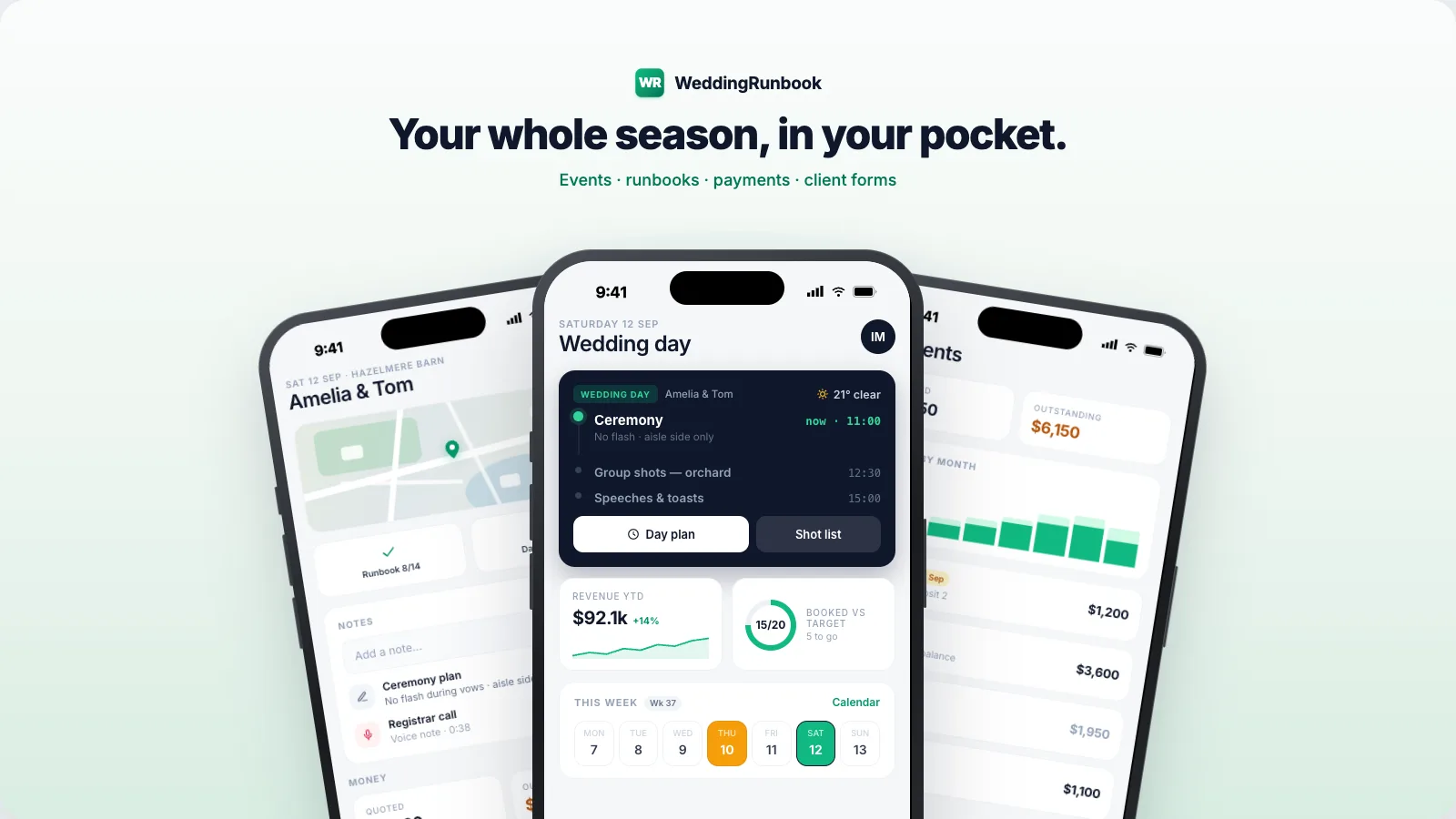
One afternoon is a timeline. A season is the hard part.
WeddingRunbook is calendar-first software for wedding photographers and videographers. Technically a CRM, but built around the event rather than the sale, so every booking carries its own dates, tasks, and deadlines. Free for 14 days, then $9 a month or $90 a year - one plan, everything included. The client portal - galleries, chat, e-signed contracts, quotes, invoices, questionnaires - is live, with 20 GB of galleries included, and the iOS app is in beta.
Start your season14-day free trial - no card required.