The wedding family photo list for photographers
Family formals are the block most likely to eat your portrait time. Here is a default list of 20 groupings, how to get real names out of the couple, how to run the block so people can leave, and a free template.
Last updated: August 23, 2026
Why the formals block eats the day
On a run sheet, family formals looks like a tidy 30-minute box. In practice it is the block most likely to run 20 minutes long and take the couple's portrait time with it. The cause is almost never photography. It is that you are standing in front of a hundred people trying to work out who counts as immediate family, while the couple is being hugged by someone they haven't seen in four years.
The fix is not a longer block. The fix is a list of names, confirmed before the day. "Mom's side" is not a list, it is a question you will have to ask out loud, in a crowd, at the one moment nobody is listening. A name behaves completely differently: you say it, the person steps forward, the frame fills, you shoot, you move on. That single change is most of the difference between a formals block that runs 35 minutes and one that runs 55.
There is a second reason names matter more than categories. Families are complicated in ways you cannot see from behind a camera. You do not know which parents are divorced, which step-parent belongs in the parents photo, or who died in March. Names force those decisions to be made by the couple, in private, weeks ahead, which is exactly where they should be made and not by you, out loud, in front of everyone.
Getting the list out of the couple
When to ask
Not at booking. A year out the couple doesn't know who is coming, and anything they write down will be wrong by the time it matters. Ask once the guest list is close to final, which commonly means four to six weeks before the wedding, around the final consult. Then confirm the finished version one to two weeks out, along with the run sheet.
What to ask for
First names for every person in every grouping, and how they relate to the couple. On top of that, four things that save you on the day: who has trouble standing, who needs a chair between shots, who is traveling and might arrive late, and whether anyone should not be placed in the same frame as anyone else. That last question needs to be asked in writing, and the answer is not something you repeat to anyone who doesn't need it.
Why a form beats a conversation
Ask this at a table and you get "oh, you know, just the usual family ones," and you write down half of it, and two of the names are wrong. A written questionnaire produces a document instead: something the couple has read, edited, and agreed to, that you can print and hand to a wrangler. It also gives them room to think about the awkward groupings without you sitting across the table watching them think.
One trick makes the response rate much better: never send a blank box. Send your default list already filled in and ask the couple to delete what doesn't apply and add what's missing. People edit far more willingly than they draft, and you get a specific answer instead of a paragraph. If you're building the rest of your client forms, the wedding photography questionnaire templates guide covers the booking, final details, and wedding day forms this one belongs in.
A default list of 20 family groupings
This is a starting point to send the couple, not a list to shoot as-is. It is ordered largest group first, which is also roughly the order you want to shoot it in. "Partner A" and "Partner B" are placeholders - replace them with the couple's names before you send it, because a form addressed to real people gets filled in and a form full of placeholders gets ignored.
| Group | Who is in it | Note |
|---|---|---|
| Everyone | The couple with both families together - parents, grandparents, siblings and their partners, aunts, uncles, cousins, and any children. | The hardest group to assemble, so call it first while the room is still full. |
| Everyone standing up with the couple | The couple with all the bridesmaids and groomsmen from both sides, plus flower kids and ring bearers. | The easiest group to find. A good warm-up while stragglers are still arriving. |
| Partner A's extended family | The couple with A's parents, grandparents, siblings and their partners, aunts, uncles, and cousins. | Agree a cutoff on cousins in advance or this quietly becomes two photos. |
| Partner B's extended family | The couple with B's parents, grandparents, siblings and their partners, aunts, uncles, and cousins. | Same cutoff, same conversation, and it needs to happen before the day. |
| Both immediate families | The couple with both sets of parents, both sets of siblings and their partners, and any nieces and nephews. | Commonly the one both mothers end up printing. Get it clean. |
| Partner A's immediate family + grandparents | The couple with A's parents, siblings and their partners, and A's grandparents. | Folding grandparents in here means they can sit down sooner. |
| Partner B's immediate family + grandparents | The couple with B's parents, siblings and their partners, and B's grandparents. | Shoot it back to back with the one above so the grandparents move once. |
| Partner A's immediate family | The couple with A's parents, A's siblings, and their partners and children. | Confirm whether siblings' partners are in or out. Ask, don't assume. |
| Partner B's immediate family | The couple with B's parents, B's siblings, and their partners and children. | The two sides often answer that partners question differently. |
| Couple + all grandparents | The couple with every grandparent present, both sides together. | Have chairs ready before you call it, then release them for the day. |
| Couple + Partner A's parents | The couple with A's mother and father. | If A's parents are divorced, ask the couple in advance whether this is one frame or two. |
| Couple + Partner B's parents | The couple with B's mother and father. | Same question, asked separately. The answers are not always the same. |
| Couple + Partner A's siblings | The couple with A's brothers and sisters. | Decide up front whether siblings' partners stay in the frame. |
| Couple + Partner B's siblings | The couple with B's brothers and sisters. | Quick one. Two minutes if the wrangler has them lined up. |
| Couple + Partner A's grandparents | The couple with A's grandparents only. | Worth doing even when you already have the all-grandparents frame. |
| Couple + Partner B's grandparents | The couple with B's grandparents only. | Then walk them to a seat yourself if nobody else does. |
| Partner A + their parents | A alone with their mother and father, no partner in the frame. | This is the one that ends up on the parents' wall. Give it thirty seconds. |
| Partner B + their parents | B alone with their mother and father, no partner in the frame. | Shoot it immediately after A's so the parents aren't recalled later. |
| Couple + their children | The couple with any children or stepchildren they're bringing into the marriage. | Do this early in the block. Small children fade fast. |
| Couple + chosen family | Godparents, the officiant, or anyone the couple counts as family who isn't on a family tree. | You will never guess these. They have to come from the questionnaire. |
Download this list as a CSV - it opens in Google Sheets, Excel, or Numbers, and it's yours to edit and send under your own name. No email required.
Sequencing it so people can leave
The order you shoot in decides how the block feels to everyone standing in it. Two rules do most of the work, and they mostly agree with each other.
- Grandparents first. They have been in those shoes since the morning and they are the people most likely to be standing when they shouldn't be. Get every frame they appear in out of the way in one run, then say out loud that they are finished and walk them to a seat.
- Largest groups first. Assemble the big group once and then subtract people from it. Calling a small group and then trying to grow it means sending someone to hunt down an uncle, and that hunt is where the minutes go.
- Never grow a group, only shrink it. If your order forces you to add people back in, the order is wrong. Rewrite it the night before, not on the day.
- Children early. Any small child in the list should be photographed in the first ten minutes, while they are still willing.
- One position, one light. Pick the spot, set your light, and do not move it for the whole block. Every reposition costs you a grouping.
End on the smallest and most personal frames - each partner with their own parents. They take seconds, they need the fewest people, and they are usually the ones that get printed.
The family wrangler, and how to brief them
You cannot shoot and gather at the same time. Someone from the family has to do the gathering, and it should be a named person agreed weeks in advance, not whoever is nearest when you start.
The right person knows names and faces on at least one side, is confident enough to call across a room, and is not already busy. That rules out the mother of the bride, who is in most of the photos, and usually the maid of honor, who is holding a bouquet and a phone and someone's lipstick. An aunt, an older cousin, or a sibling's partner is often ideal. If the couple has a coordinator, ask the coordinator who they'd pick.
Brief them properly. Give them their own printed copy of the list the night before, walk them through it once, and tell them the single thing that makes the block work: their job is to have the next group standing behind you while you are still shooting the current one. Give them the exact wording too, because most people freeze without it. Something like "Rob, Susan, Katie - you're next, come stand behind the photographer" works far better than "can we have the bride's family please."
Divorce, blended families, and recent losses
This is the part of the list that deserves the most care, and it is handled entirely before the day or not at all.
Put two quiet questions in the questionnaire. The first: is there anyone who would prefer not to be photographed in the same group as someone else. The second: is there anyone we should be especially gentle with on the day. Both are easy to answer in writing and almost impossible to answer well out loud. Whatever comes back is the couple's information, and it travels no further than the wrangler, and only as much of it as they need to run the list.
Divorced parents. Do not decide this yourself. Ask the couple directly whether the "couple with A's parents" frame is one photo or two, and take their answer without commentary. Plenty of divorced parents will happily stand together for one frame. Plenty will not. When the answer is two, shoot them back to back so neither one is left standing around watching the other.
Blended families. Ask explicitly whether step-parents are in the parents photo. The answer is often both: one frame with step-parents included and one without. Write both rows into the list rather than deciding on the day, and use the names the couple uses when you call the group.
Someone who has died. If a parent or grandparent died recently, calling that grouping by its usual name will land hard on people already having a difficult day. You need to know before you open your mouth. Ask the couple whether they would like the absence acknowledged in a frame - an empty chair, a photograph held, a ribbon on the bouquet - or not marked at all. Both answers are right, and it is not your call to make. If they say nothing, shoot the list as written, quietly and quickly, and do not draw attention to the gap.
How long the block actually takes
The planning number worth using is two to three minutes per grouping once you are set up and the wrangler is feeding people to you. That covers calling the group, placing them, fixing the one person who is squinting, and taking enough frames that everyone has their eyes open in at least one. Fewer than two minutes assumes everything goes right, which it won't for all 20.
So a 20-group list is roughly 40 to 60 minutes of shooting, plus about ten minutes at the front for gathering people and setting up. That is the real size of the block. Put that number on your run sheet honestly, because a 30-minute box holding an hour of work is how portrait time disappears.
If the timeline genuinely only has 30 minutes, cut the list to 10 or 12 groupings with the couple in advance. Cutting in the calendar is a conversation. Cutting in a field with 40 relatives watching is not.
When the list explodes on the day
It will. Someone's aunt will ask for a photo with her grandchildren, someone will realize the college friends never got one, and the couple will say yes to all of it because they are being asked in front of people. Plan for this instead of resisting it.
- Say yes, but move it. "Absolutely - find me during cocktail hour and we'll do it there" costs you nothing, keeps the block intact, and half of those requests never come back to you.
- Requests go to the wrangler. Tell them at the briefing that this is part of the job. You should not be negotiating while holding a camera and 12 people.
- Trade, don't add. If the couple wants something added right now, ask which group on the list they would rather drop. It is a fair question and it usually answers itself.
- Know your stop time. Decide before you start what time you walk away, and tell the couple and the coordinator what it is. A stop time you announced is a plan. A stop time you invent under pressure is an argument.
Then treat the confirmed list as an attachment to the timeline itself. A run sheet with an unconfirmed formals list is a run sheet with a hole in it, and the hole always opens in the same place - right where the couple's portraits were supposed to be.
Common questions
How many family groupings should I plan for?
Somewhere between 15 and 25 is a workable range for a standard wedding, and the list below has 20. The number that matters more is the time you have. Count your groupings, multiply by two to three minutes, add ten minutes to gather everyone, and see whether the answer fits the block on your run sheet. If it doesn't, cut the list with the couple before the day rather than in a field on the day.
What's the difference between a shot list and a family photo list?
A shot list is the couple telling you what moments they want covered across the whole day, and past a handful of must-haves it mostly gets in your way. A family photo list is different: it's a roll call of posed group photos that literally cannot happen unless specific named people are standing in one place at one time. That's why it's the one list worth insisting on.
Should family formals happen before or after the ceremony?
Before, if the couple is doing a first look and the family can be persuaded to arrive early. You get better light, calmer people, and a cocktail hour you can actually shoot. Without a first look, formals commonly land immediately after the ceremony, while everyone is still in the room and nobody has found the bar yet. Either way, do them in one continuous block rather than scattering them.
What do I do when the couple sends me groupings instead of names?
Send it back with the groupings filled in as far as you can and blanks where the names go. Asking someone to complete a mostly finished document is far easier than asking them to write one, and it turns a vague answer into a specific one. If they still can't name everybody, that grouping is a candidate for cutting, because it will not assemble quickly on the day either.
Who should hold the printed list on the wedding day?
You keep one copy, and a family wrangler keeps the other. The wrangler is a person from the family who knows names and faces, isn't in most of the photos, and isn't already busy running the day. Their job is to have the next group standing behind you while you shoot the current one. Give them the list the night before, not thirty seconds before you start.
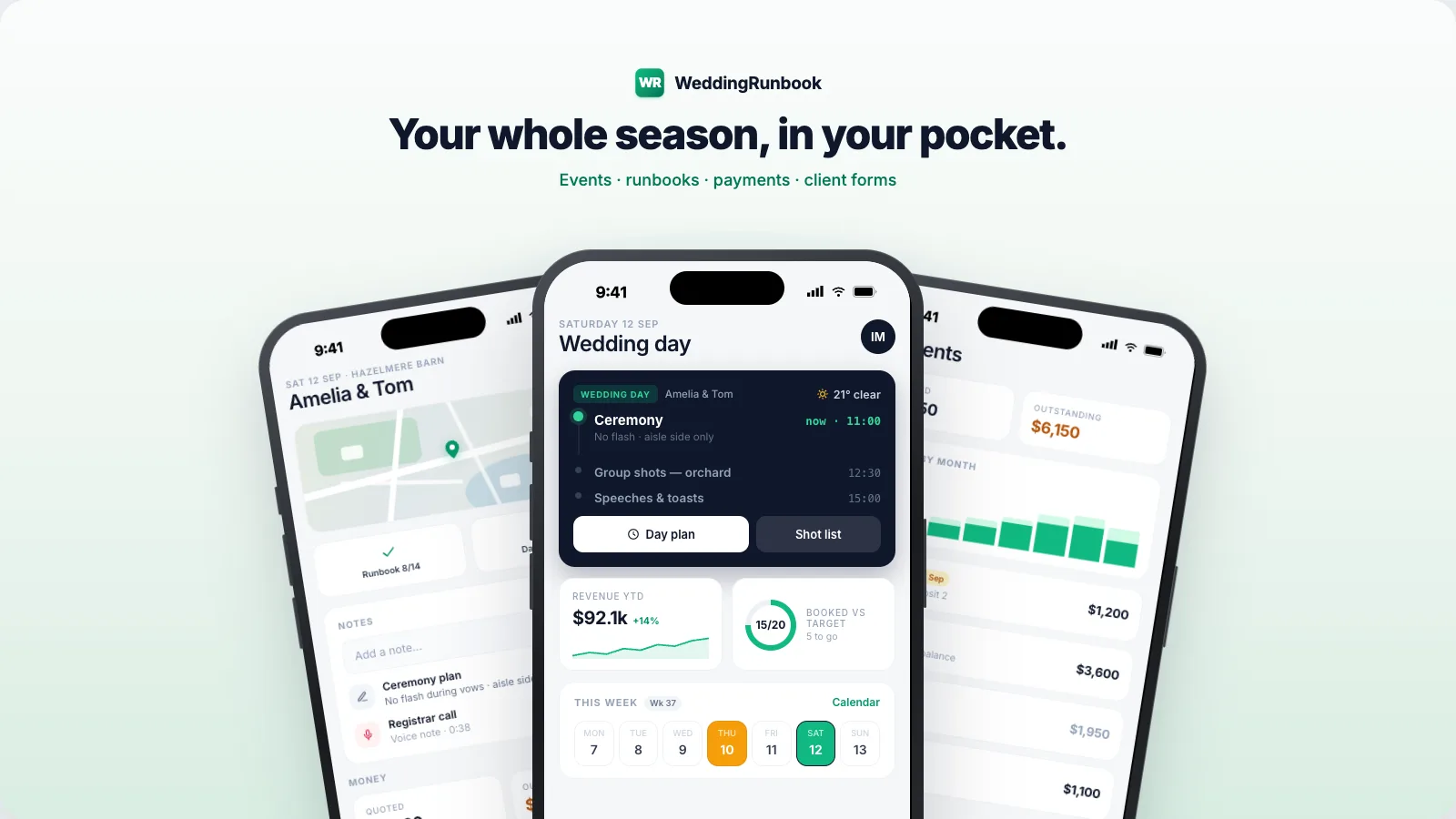
The formals list is one page. WeddingRunbook holds the rest.
WeddingRunbook is calendar-first software for wedding photographers and videographers. It's technically a CRM, but it's built around the event rather than the sale, so every wedding carries its own deadlines, tasks, and questionnaires - client questionnaires are built in, so the family list lives with the wedding instead of in your inbox. Free for 14 days, then $9 a month or $90 a year - one plan, everything included. The client portal - galleries, chat, e-signed contracts, quotes, invoices, questionnaires - is live, with 20 GB of galleries included, and the iOS app is in beta.
Start your season14-day free trial - no card required.