Working with a wedding second shooter
When you actually need one, where to find someone you can trust with a day you cannot reshoot, the brief that keeps them working without you, and how to agree a rate and pay it.
Last updated: August 23, 2026
When you actually need one - and when you don't
A second shooter is not an upgrade you add because a wedding feels big. It is a fix for a specific coverage problem, and if you cannot name the problem, a second person just makes the day busier. Where a second body earns its place:
- Two getting-ready locations. Not two rooms down the hall - two addresses with traffic between them. Cutting one side short is what couples notice a year later.
- A guest count you cannot walk. Once a lap of the room takes real time, candid coverage thins out. Where that threshold sits depends on your venue and your pace.
- A ceremony that needs two angles at once. The vows happen one time. If the couple want the wide from the back and the faces from the front, and the officiant restricts movement, that is two people or it is a compromise.
- Parallel action at the reception. Toasts and reactions, the cake and the dance floor. Two things worth photographing, in different directions.
- A video crew is on the day. With a camera team working the same corners, your own coverage gets tighter. A second shooter buys back the angles you now have to give up.
The honest other half: a single-venue wedding with a modest guest count, a generous timeline, and a couple who want a quiet presence rarely needs one. Neither does a day whose real problem is the schedule. If formals are crammed into fifteen minutes, a second shooter does not create time - a better wedding day run sheet does. Fix the plan first, then decide whether you still need the person.
Where to find one
The pool is smaller than it looks online, and the good people get booked early in the season. The routes that actually work:
- Photographers already booked that date. Ask the shooters you would have hired yourself. The one who is unavailable often hands you a name, with their own reputation behind it.
- Local photographer groups and meetups. You learn more about whether someone is easy to work with over a coffee than from a feed.
- Groups set up for second shooting. People post the dates they are free, photographers post the dates they need covered. Treat every name as a stranger until you have seen the work and asked for a reference.
- People who have assisted for you. The safest route of all. Bring someone as an assistant first - carrying, holding light, wrangling family - and you learn how they handle pressure and timekeeping before you hand them a block of the day.
What does not work is booking off a grid of twelve beautiful frames. A feed shows you someone's best hour, not their worst one.
What to check before you book someone
A full gallery in something close to your style
Ask to see a complete delivered wedding, not a highlight set. You are looking for consistency across eight hours: does the exposure hold when the light gets ugly, do they still deliver in the dark. Their color need not match yours, since you are editing everything anyway, but their instincts about what is worth photographing should.
Reliability signals
Watch how they behave before the booking. Do they answer within a day, confirm details without being chased, ask sensible questions about the timeline. If the name came from another photographer, ask directly: did they turn up on time, would you use them again. A vague answer is an answer.
Their own insurance and backup bodies
Ask whether they carry their own liability insurance, because some venues want proof from everyone working the day. Ask what they will bring: a second body to switch to when the first one fails, dual card slots if the camera has them, enough batteries and cards to get through the night without borrowing yours. One body and one card is a risk you would be taking on.
Card handling habits
The question that separates people who have lost a wedding from people who have not. Do they shoot to two cards. When do they format, and where do used cards live during the day. Someone who has thought about it answers immediately. Someone who has not says it has never been a problem.
The brief: write it down before the day
A brief is one page they can read on their phone in the car. It exists so that on the day you are photographing a wedding instead of answering questions. Send it in the week before, not the night before, so there is time to ask about anything unclear.
| Section | What to put in it |
|---|---|
| Call time and address | Exact address, arrival time, where to park, which entrance, and your mobile number. Add the venue coordinator's name if you have it. |
| Dress code | What to wear and what not to. Say it plainly rather than hoping. Include shoes if the venue is grass, gravel, or sand. |
| Coverage split by block | Who is where, block by block: getting ready, ceremony, formals, cocktail hour, reception. The core of the brief, and the part people skip. |
| Who covers whose side | Name the partner, family, bridesmaids and groomsmen each of you is with, and say when that swaps. Use names, not roles, so nobody guesses at the door. |
| Their shots alone | The frames only they can get because you are elsewhere: the aisle reaction, the second ceremony angle, the room before guests enter. List them so they are jobs, not hopes. |
| Card and backup rules | Dual card slots on if the body has them. Never format in the field. Cards stay in a pocket, not in a bag on a chair, and used ones have one agreed home. |
| How files are handed over | Cards to you at the end of the night, or an upload within an agreed number of days. If they leave with the cards, name the deadline and say nothing gets deleted until you confirm you have the files. |
| Editing and delivery | They hand over raw files; the edit and the client delivery are yours. Nothing goes to the couple from them, ever. |
| Portfolio use and credit | Whether they may post any images, which versions, where, when, and how you are credited. If the answer is no, say no here rather than after they post. |
| Payment terms | The rate, what it covers, when overtime starts, how travel and expenses work, and the date payment lands. Ask for an invoice. |
Attach the run sheet to it. The brief says what they own; the run sheet says when everything happens. Send both, and carry printed copies, because venues eat phone signal.
Running the day without managing them minute by minute
If you are directing a second shooter all day, you are shooting one wedding with two cameras instead of covering it twice. The brief is where the managing already happened. On the day, four things keep it that way:
- Give them blocks, not instructions. "You have the groom's side until dress-on, then you are on guest arrivals" is a job they can run. "Get some candids" is not.
- Agree two or three check-ins. After the ceremony, before dinner, once late on. Thirty seconds each. Everything in between is theirs.
- Say what happens when a block ends early. Default them to something useful - details, the room, guests - so they never stand around waiting to be told.
- Decide who talks to the couple. Usually you. Tell them how to handle a parent asking for a group photo: take it, be gracious, and tell you afterward rather than rebuilding the timeline on their own.
And the hardest one: do not stand behind them looking at their screen. You hired their eye. Give the feedback afterward, once, in a form they can use next time.
Photo and video on the same wedding
When both crews work the same day, the coordination problem doubles. Three agreements settle almost all of it, and they are worth a short call in the week before rather than a whispered negotiation at the back of a church.
- Agree corners. At the ceremony, each person gets a position and stays broadly in it. The classic failure is a video camera in every photo of the vows and a photographer in every clean video shot.
- One master timeline. Not a photo timeline and a video timeline that drift apart the moment hair and makeup runs long. One document, agreed with the planner or the couple, each crew knowing its own jobs per block.
- Decide who leads which block. Family formals are photo-led and video shoots cutaways. The couple session needs a split so video gets directed movement rather than the same poses from a second angle.
If you are the video side of that pairing, the run sheet for videographers covers the parts that never appear on a photographer's plan: rig windows, audio capture, and media handling.
Paying them
Money is the part people avoid until it is awkward, which is why it belongs in the brief. None of this is legal or tax advice: whether a second shooter is treated as an independent contractor or an employee, and the paperwork that goes with it, varies by country and sometimes by region, so ask an accountant or lawyer where you work.
Day rate or hourly
A day rate is cleaner when the coverage window is settled: one number, and both of you know what it buys. An hourly rate with a stated minimum suits days that might stretch, and stops a ten-hour wedding being paid like a six-hour one. Either way, write down what the rate covers, when overtime starts, and what happens to travel, parking, and an overnight stay. Set the number by what the day is worth in your market and what this person is worth to your coverage, and agree it before the booking.
When the payment lands
Pick a date and put it in writing: on the night, within a set number of days after the wedding, or on receipt of the files. Any of those is fine. What is not fine is "when the couple pays me." Your cash flow is not their problem, and someone left waiting on a client balance will not work with you twice.
Invoicing
Ask for an invoice with their details, the wedding date, and the agreed rate. It keeps your books straight and gives you both a record later. If they do not invoice, file the written agreement and the payment record with that wedding.
The mistakes that cost you a wedding
- No brief. You spend the day answering questions instead of photographing, and the frames nobody was assigned are the ones that turn out to be missing.
- No backup plan. Second shooters get sick in the same week couples do. Have a second name you could call, and know what you would tell the couple if you had to shoot the day alone.
- Assuming portfolio rights. They assume yes, you assume no, and the conversation happens after the images are posted. Two lines in the brief prevent it.
- Hiring on style alone. Beautiful work and a habit of arriving late are entirely compatible. Check both.
- Booking a photographer and using them as an assistant. If you need someone to hold light and carry bags, hire an assistant and say so. Never letting a second shooter photograph is how you lose them.
Common questions
What does a second shooter actually do on a wedding day?
They cover what you cannot be standing in front of: the other getting-ready location, the second ceremony angle, guest reactions while you shoot the vows. If you cannot name the blocks they own before the day, you do not have a second shooter, you have a passenger.
How do I find a second shooter for a wedding?
Referrals from photographers already booked that date are the most reliable route, because the person referring has a reputation on the line. After that: local photographer groups and meetups, groups set up for second shooting, and people who have assisted for you before. Work seen online is a starting point, not a booking decision.
Should I pay a day rate or an hourly rate?
A day rate is simpler when the coverage window is settled. An hourly rate with a stated minimum protects them on a long day and you on a short one. Whichever you pick, write down what the rate covers, when overtime starts, and how travel is handled, and agree it before the booking.
Can a second shooter use the images in their own portfolio?
Only if you have both agreed to it in writing, and never assume the answer either way. Decide four things in advance: whether they may use images at all, which versions, where they may post them, and how you are credited. Allowing a small selection of your edits with credit is one workable answer; allowing none is another. The argument only happens when nobody said.
Do I need a written agreement with a second shooter?
Put the terms in writing before the day, every time, even for someone you know well. That is practical advice, not legal advice: whether a second shooter counts as a contractor or an employee, and what paperwork that requires, varies by country. Ask an accountant or lawyer where you work.
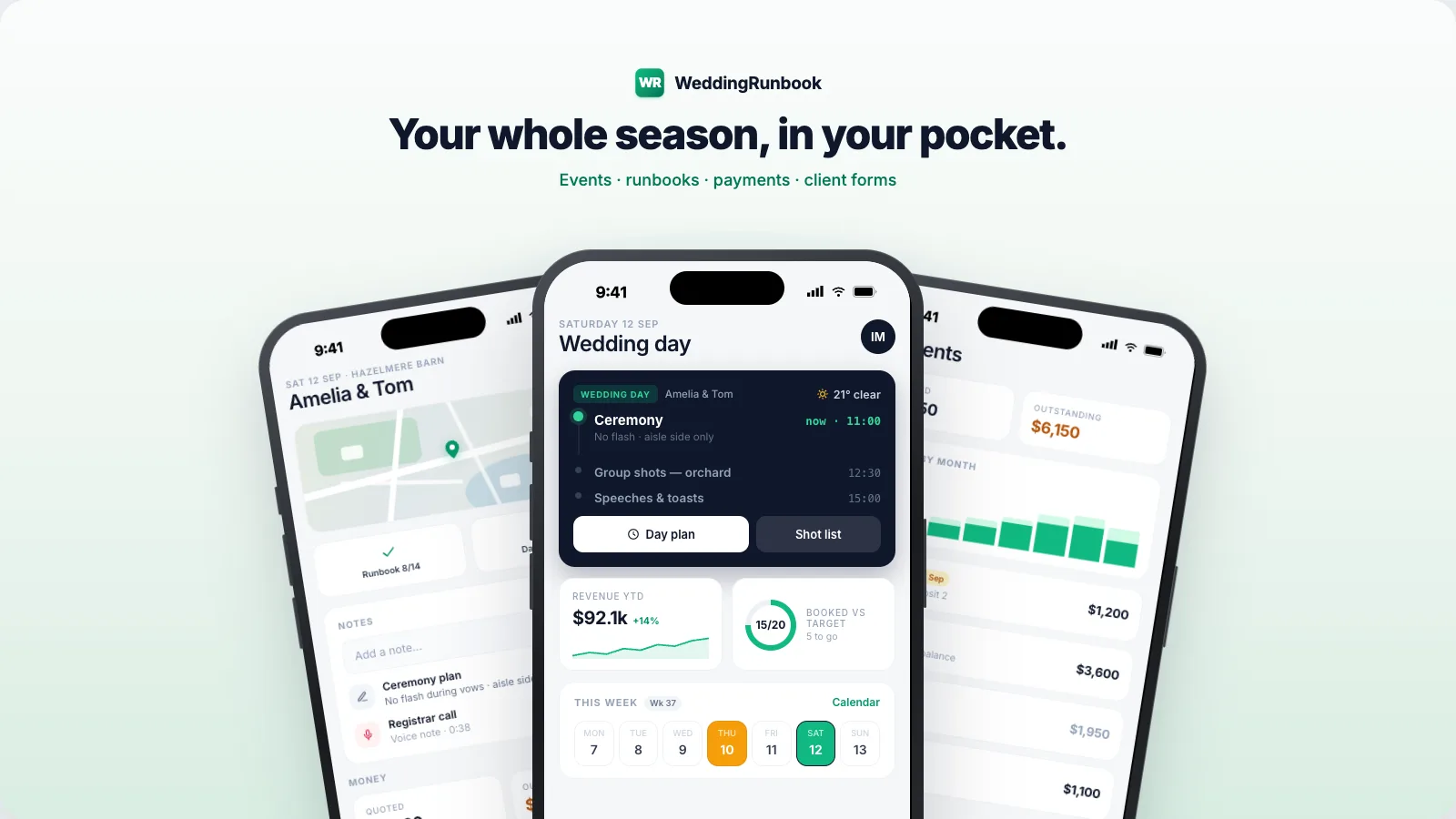
One wedding has a brief. A season has fourteen of them.
WeddingRunbook is calendar-first software for wedding photographers and videographers, solo or working as a team. It is technically a CRM, but built around the event rather than the sale, so every wedding carries its own deadlines, tasks, and day plan. Free for 14 days, then $9 a month or $90 a year - one plan, everything included. The client portal - galleries, chat, e-signed contracts, quotes, invoices, questionnaires - is live, with 20 GB of galleries included, and the iOS app is in beta.
Start your season14-day free trial - no card required.