How to price wedding videography packages
Your price is not a number you find on a forum. It comes out of three things only you can work out: the hours a wedding really takes you, what your year costs to run, and how many weddings you can deliver well.
Last updated: August 22, 2026
Why wedding video gets under-priced
Most pricing advice starts in the wrong place: a number somebody else charges. Borrow it and you inherit everything behind it you cannot see - their edit style, their volume, their overhead.
Video gets under-priced for a specific reason: the visible part of the job is the smallest part. The couple watches you work for eight or ten hours, so that is what the price feels like it should cover. But your post is multicam, with audio to sync and level, color to match across bodies, and a story to write before a single cut lands. The day is raw material. The film is the product, and it gets made on weekday evenings in November.
The fix is unglamorous and it works. Count the hours, add up what the year costs, divide by the weddings you can actually deliver. That gives you a floor.
Step one: count your real hours
Take a wedding you have already delivered and account for every hour, from the first inquiry email to the moment the footage went to archive. The example below is one videographer, an eight-hour day, a highlight film plus a full ceremony edit. The hours are illustrative, not a standard.
| Stage | Hours | What is in it |
|---|---|---|
| Inquiry, quote, booking | 3 | Replies, a discovery call, the quote, the contract |
| Planning | 3 | The planning call, the run sheet, the audio plan, vendor emails |
| Travel and load | 4 | Drive time both ways, load in and out, gear prep |
| Shoot day | 8 | The hours the couple sees and thinks they are paying for |
| Ingest and backup | 3 | Verified offload, three copies, one of them offsite |
| Culling and syncing | 8 | Multicam sync, audio sync, a full review pass, selects |
| Edit passes | 22 | Assembly, story, color match and grade, sound mix, exports |
| Revisions | 3 | The rounds you included in the contract |
| Delivery | 3 | Uploads, link setup, the handover email, archive |
| Admin | 3 | Invoicing, bookkeeping, storage housekeeping |
| Total | 60 | One wedding, start to finish |
Sixty hours, and the shoot day is eight of them - a bit over one hour in eight. Quote a day rate and you are pricing an eighth of the job. When a couple says the price seems high for a day of filming, they are right, and they have no idea the other fifty-two hours exist.
Two sets of hours get missed: the work outside any single wedding, like the inquiries that never booked, which the weddings that did book have to pay for; and the work hiding in the cracks, like the export that failed at ninety percent.
Step two: your cost of doing business
Cost of doing business is a plain question: what does a year of running this business cost before any profit? Write an annual figure against each of these, using your own numbers.
- Gear replacement and depreciation. Not what you spent this year, but what it costs annually to keep a working kit alive: the replacement cost of each item divided by the years it realistically lasts. Gear dies mid-season.
- Insurance. The liability cover venues ask for, plus equipment cover.
- Software subscriptions. Editing and color, plugins, music licensing, cloud delivery, website, and whatever runs your bookings. Small monthly numbers add up to a line that surprises people once a year.
- Storage and archive. Working drives, backups, the offsite copy, and the archive tier holding delivered weddings for as long as you promised.
- Travel and vehicle. Fuel, parking, servicing, and the share of a car that exists because of this work.
- Tax and contributions. Set aside as a cost rather than discovered as a bill. Ask your accountant for your real rate.
- Marketing and business services. Advertising, listings, your accountant, payment processing fees, education.
- Sick days and unpaid weeks. Nobody pays you when the season stops or when you get the flu. Decide how many weeks a year you are not earning, and let the earning weeks carry them.
- The salary you intend to pay yourself. The line most people leave out, and the most important one. Decide what you need to live on before you price anything, and treat it as a cost like any other. Profit is what remains after the business pays you.
Step three: turn it into a floor price
Now put the halves together. The figures below are illustrative, chosen only so the arithmetic is visible. They are not a recommendation and not a market rate - swap in your own and the method still works.
| Line | Example figure | Where it comes from |
|---|---|---|
| Business running costs | $18,000 | Gear, insurance, software, storage, travel, marketing |
| The salary you pay yourself | $45,000 | Decided first, not left over at the end |
| Tax set aside | $15,000 | Whatever your own rate works out to |
| Total the year must produce | $78,000 | The three lines above, added up |
| Weddings you can deliver | 20 | Working hours divided by the hours one wedding takes |
| Floor price per wedding | $3,900 | $78,000 divided by 20 |
The weddings line is the one people get wrong. It is not how many dates are free, it is how many you can deliver at your standard without the edit queue eating the next booking. A season you cannot deliver is worse than one you did not book.
What comes out is a floor, not a price. Below it, the wedding costs you money to shoot. Your price sits above it, and the gap is where profit and surviving a slow year live. If the floor lands higher than you think couples near you will pay, there are three honest responses: raise the price and market to people who pay it, simplify what you deliver so it takes fewer hours, or take fewer weddings at a higher price. Working below your floor is not one of them.
Package structure that works
With a floor in hand, packages are about making the choice easy. Three options holds up: a clear entry, one obvious middle, an ambitious top. Seven options is a decision the couple postpones.
The entry package
A real product you are happy to put your name on, not a stripped shell built to be rejected. Shorter coverage, one film, one shooter. It exists so a couple who cannot reach your middle price still pays you above your floor.
The middle package
The one you want to sell, so build it deliberately. Put in the deliverables you most want to make, the coverage length that produces your best work, and the add-on that quietly makes your day easier. Price the entry so the step up feels small next to what it adds, and make the middle the package your site and your reply email describe by default.
The top package
Ambitious on purpose: the wedding you would love to shoot. Two days, extra shooters, a feature-length edit, a same-day teaser. It sells occasionally, and the rest of the time it sets the ceiling and makes the middle read as sensible rather than expensive. Make it genuinely better, though - a top package that is the middle with a drone bolted on is transparent.
Name packages by what they deliver
Not by metal or tier. Coverage hours, which films, approximate lengths, number of shooters, delivery window. Every vague word is a disagreement you have agreed to have later.
What to charge for separately
Anything that costs you real extra work, or that can be cancelled by something outside your control, belongs outside the base price.
- Drone, as a conditional add-on. Weather, airspace, venue policy, and licensing can each ground it on the morning. Sell it as its own line with the conditions written down, so a grounded drone is a disappointment rather than a refund.
- Raw footage. Decide the policy once and put it in the contract. If you sell it, price it as a product, with a stated format and a caveat that it is ungraded and as shot.
- Extra hours. Publish an overtime rate at booking. Agreed in advance, a reception running long becomes a one-line text instead of a negotiation.
- Second shooter. Their day rate, your time briefing them, and the extra edit hours their footage creates. A second camera adds work in post, not just on the day.
- Rush delivery. It costs every other couple their place in the queue, so charge properly and cap how many you take.
- Travel beyond a stated radius. Publish the radius included, then quote mileage, flights, and accommodation per event.
- Extra edits and keepsakes. Social cuts, a teaser, an anniversary re-edit, a drive or album. Each is separate work, and each sells best after delivery, when they have just watched their film.
The two package mistakes that cost real money
Unlimited revisions
It sounds like service and it is an open-ended labor commitment you priced at zero. It also produces worse films, because a couple with unlimited attempts edits by committee instead of reacting to a finished piece. Include a defined number of rounds, and define a round as one set of consolidated notes sent within a stated window, covering music, pacing, and swapping shots. Restructuring the story is a re-edit, and it has its own price, stated in the contract at booking.
Undefined deliverables
If your package says the film, you and the couple are picturing two different products. A highlight film and a full documentary edit are wildly different amounts of work, and the gap is where unpaid weeks come from. Name each deliverable, give an approximate length, and state the delivery window. The wedding videography workflow guide covers the delivery side. Pricing and delivery are the same conversation held at two different times.
How to raise prices without losing the season
If the arithmetic just told you that you have been under your floor, the instinct is to double the price on Monday. Do it in a way that survives a real season.
- New inquiries only, from a stated date. Every signed booking is honored at the price agreed. Nobody who has paid a retainer should hear about a change.
- Move in steps, each season. Regular, moderate increases are easier to hold your nerve on than one leap, and they let you read the effect before the next one.
- Change the package at the same time. Add a deliverable, extend the coverage, improve the handover, so the higher number attaches to something visible.
- Raise the entry package first. It is the floor of the whole structure, and lifting it stops the cheapest option from quietly setting your income.
- Judge the season, not the inquiry. Some couples will say no, and some would have anyway. What matters is booked revenue across the season.
- Answer everyone the same way. Discounting case by case teaches you that your price is negotiable, and it is unfair to the couple who paid it. Point a tight budget at the shorter package instead.
Quoting photo and video together
When you work alongside a photographer, couples will ask for one price. Give them one document with two line items inside it. The work is separate, the hours are different, and if one of you becomes unavailable the couple should see what they are still buying.
- Decide who holds the contract. Either you both contract the couple directly, or one leads and the other is a subcontractor at an agreed rate. Both work. Working it out after a refund request does not.
- Price video on video hours. The post hours are not comparable, so do not let the photography half set the combined number. Run your own floor calculation.
- Make any combined saving real. Booking together does save you something - one planning call, shared travel. Size the discount to that, not to a round number that feels generous.
- Agree the day split before you quote. Who leads formals, who directs the couple session, how long each of you needs.
Keep the numbers where the dates are
Pricing stops being theoretical the moment the season starts. The floor you worked out in January is only useful if it is in front of you when a couple emails in June. Redo the hours count once a year against a wedding you actually delivered, revisit the cost of doing business when the gear changes, and keep quotes and invoices attached to the dates they belong to rather than scattered across a folder, an inbox, and a spreadsheet.
Common questions
How much should I charge for wedding videography?
There is no honest single number, because it depends on your costs, your edit style, and how many weddings you can deliver well in a year. Work it out instead: count every hour one wedding takes from first inquiry to archive, add up what your year costs to run including the salary you intend to pay yourself, then divide that by the weddings you can realistically deliver. That is your floor, and your price sits above it.
How many revision rounds should a wedding video package include?
Include a defined number - two rounds is a common and workable choice - and define what a round is. One round means one set of consolidated notes, sent within a stated window, covering things like music choice, pacing, and swapping specific shots. Anything beyond that is billed at a stated hourly rate. Unlimited revisions is not generosity, it is an open-ended labor commitment you priced at zero.
Should drone footage be included in the price?
Commonly it works better as a conditional add-on than as a bundled feature. Flight depends on weather, airspace, venue permission, and your licensing - four things that can ground it on the morning through no fault of yours. Bundled into the package price, a grounded drone becomes a refund conversation. As a separate line item that is explicitly conditional, the couple understands the risk when they buy it.
Should I charge less for a shorter wedding day?
Charge less, but not proportionally less. A six-hour day does not cost you six-tenths of a ten-hour day, because the inquiry, the planning call, the travel, the ingest, the color pass, and the sound mix barely move. Coverage hours are the one line that shrinks. Build a shorter package around a smaller deliverable set rather than a discount, so the price drop matches a real drop in your work.
How do I raise my prices without losing the season?
Apply the new price to new inquiries from a stated date, honor every booking already signed, and move in steps each season rather than one leap. Change something in the package at the same time so the higher number attaches to something visible. Then judge the season's booked revenue rather than reacting to individual couples who say no. If every inquiry books instantly, that usually means the price was low.
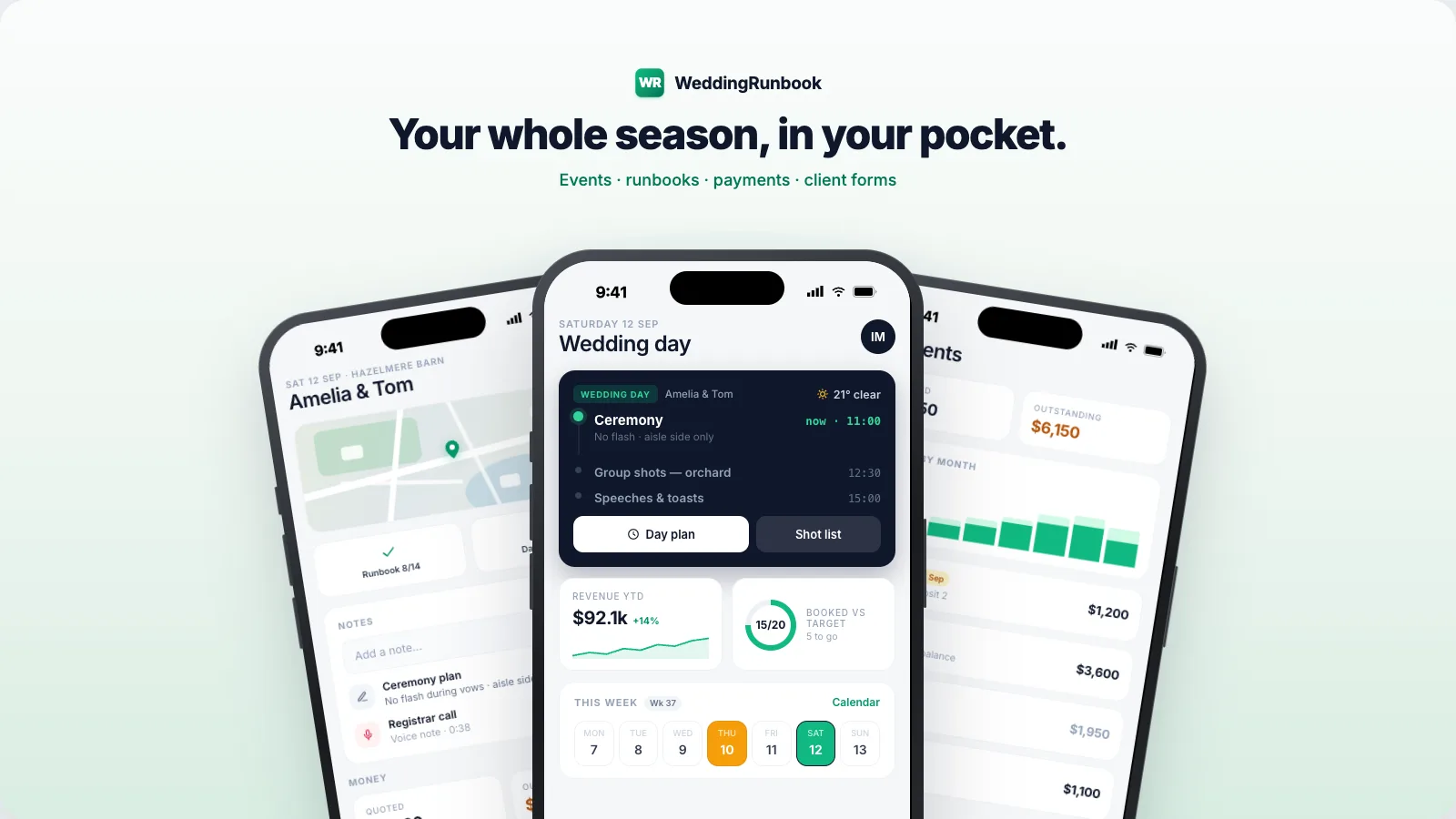
Your prices, your quotes, and your dates in one place.
WeddingRunbook is calendar-first software for wedding photographers and videographers - weddings first, any dated event. Technically it's a CRM, but it's built around the event rather than the sale, with quotes and invoices attached to the booking they belong to. Free for 14 days, then $9 a month or $90 a year - one plan, everything included. The client portal - galleries, chat, e-signed contracts, quotes, invoices, questionnaires - is live, with 20 GB of galleries included, and the iOS app is in beta.
Start your season14-day free trial - no card required.